
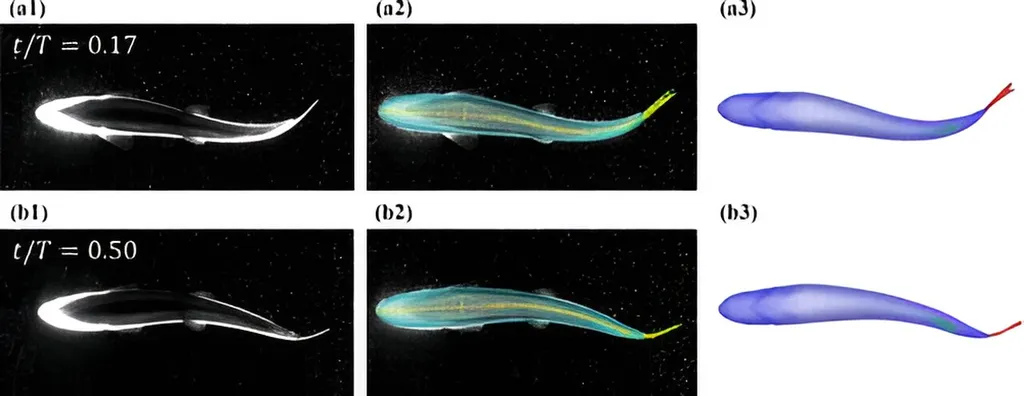
Researchers from the University of Science and Technology of China have unveiled a groundbreaking study on how trout optimize their swimming efficiency, offering valuable insights for biomechanics, fluid dynamics, and engineering. The team, led by Tao Li and including Chunze Zhang, Weiwei Yao, Junzhao He, Ji Hou, Qin Zhou, and Lu Zhang, created a bio-inspired digital trout to explore the intricacies of energy transfer in carangiform swimming.
The study addresses a critical gap in traditional research by linking neuromuscular control to whole-body movement. The researchers developed a sophisticated model that combines multibody dynamics, Hill-type muscle modeling, and a high-fidelity fluid-structure interaction algorithm. This model accurately replicates the form and properties of a real trout, providing a robust platform for their investigations.
Using deep reinforcement learning, the team enabled the digital trout’s neural system to achieve hierarchical spatiotemporal control of muscle activation. This advanced approach allowed them to systematically examine how different activation strategies affect swimming speed and energy consumption. The findings reveal that axial myomere coupling—where activation spans over 0.5 body lengths—is essential for stable body wave propagation. This coupling ensures that the waves of muscle contractions travel smoothly along the fish’s body, enhancing propulsion.
The study also highlights the importance of moderate muscle contraction duration, ideally between 0.1 and 0.3 of a tail-beat cycle. This range allows the body and surrounding fluid to act as a passive damping system, significantly reducing energy use. The researchers discovered that the activation phase lag of myomeres plays a crucial role in shaping the body wave. If this lag is too large, it can lead to antagonistic contractions that hinder thrust, thereby diminishing swimming efficiency.
These insights are not just academic; they have practical applications for designing energy-efficient underwater systems. By understanding how trout regulate muscle contractions to optimize propulsion, engineers can develop more efficient and effective underwater vehicles. The study’s findings could also inform the design of bio-inspired robots and other technologies that mimic natural locomotion.
The research underscores the importance of interdisciplinary approaches in advancing our understanding of biological systems. By integrating biomechanics, fluid dynamics, and advanced computational techniques, the team has provided a comprehensive analysis of fish locomotion. Their work not only sheds light on the intricate mechanisms of efficient swimming but also paves the way for innovative applications in engineering and technology. Read the original research paper here.