
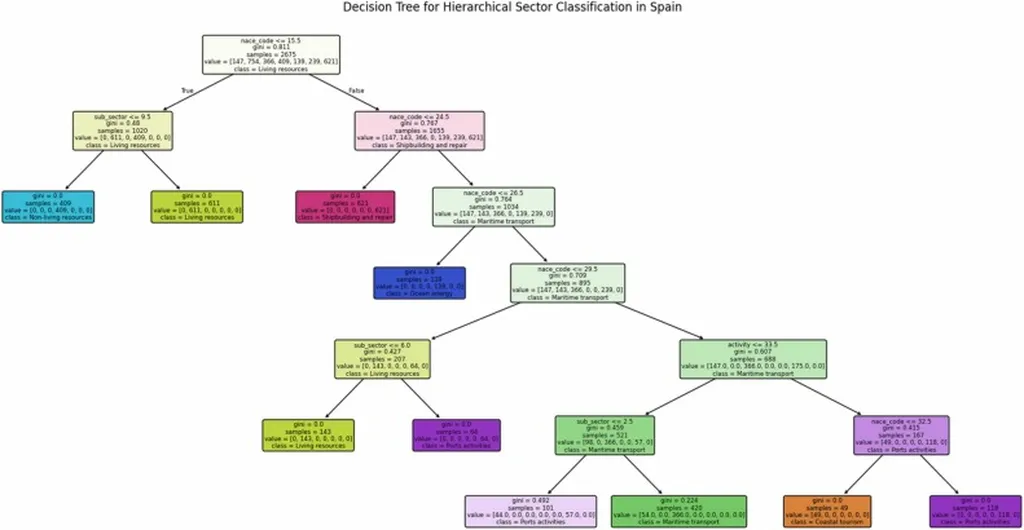
In a bid to chart a course for sustainable growth in the maritime sectors, a recent study published in *European Transport Studies* (or *European Transport Research* in English) has turned to decision trees to prioritize key Blue Economy sectors in Spain and Europe. The research, led by Javier Vaca-Cabrero from the Universidad Politécnica de Madrid, offers a fresh perspective on how to balance economic, social, and environmental factors in the maritime industry.
Vaca-Cabrero and his team dove into data from official sources, focusing on sectors like maritime transport, coastal tourism, port activities, shipbuilding, marine resources, and ocean energy. They used decision trees, specifically the CART algorithm, to sort through the data and identify which sectors are driving growth and where investments might pay off.
So, what did they find? Well, it turns out that maritime transport and coastal tourism are the big players in Spain. These sectors aren’t just bringing in the cash; they’re also creating jobs and shaping the country’s economic landscape. Vaca-Cabrero noted, “In the Spanish case, maritime transport and coastal tourism appear as prominent sectors, reflecting their strong specialization and contribution to GDP and employment.”
But Europe as a whole tells a slightly different story. While maritime transport and port activities still hold sway, there’s a growing buzz around ocean energy. This sector, though still emerging, is gaining traction and could be a game-changer in the long run. Vaca-Cabrero explained, “At the European level, maritime transport and port activities show broader diversification, while emerging sectors such as ocean energy are gaining visibility.”
The study highlights the need for tailored approaches in different regions. What works in Spain might not necessarily work in other parts of Europe, and vice versa. This means that policymakers and industry leaders need to be strategic about where they invest their resources.
From a commercial standpoint, the findings offer a roadmap for stakeholders in the maritime sector. Investing in maritime transport and coastal tourism could yield significant returns in Spain, while diversifying into port activities and ocean energy might be the way to go in Europe. The study also underscores the importance of supporting regional specialization and promoting emerging sectors.
Vaca-Cabrero’s research provides a transparent, rule-based method to identify sectoral patterns and inform decision-making. By aligning national priorities with the European Green Deal and advancing the energy transition, the maritime sector can navigate towards a more sustainable and prosperous future. As the study suggests, “policy actions such as infrastructure investment, the promotion of emerging sectors, and support for regional specialization may be considered.”
In essence, this research isn’t just about crunching numbers; it’s about steering the maritime industry towards smarter, more sustainable choices. And for maritime professionals, it’s a call to action to leverage these insights and drive growth in their respective sectors.