
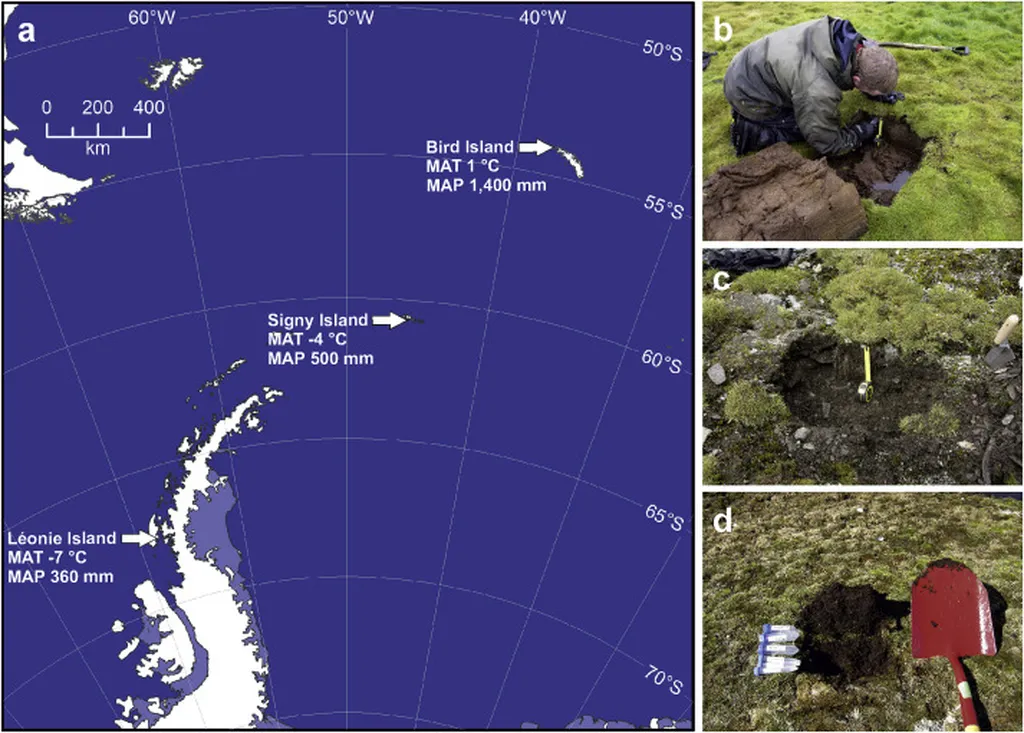
In the frosty, windswept landscapes of Maritime Antarctica, a team of researchers led by Ivan Carlos Carreiro Almeida has been digging deep into the soil, quite literally, to understand how it forms and interacts with the sparse vegetation that calls this harsh environment home. Their work, published in the journal Derbyana (which translates to “Derbian Studies”), sheds light on the intricate dance between soil types, geomorphology, and plant life at Lions Rump, King George Island.
So, what’s all the fuss about soil in Antarctica? Well, for starters, understanding soil formation and distribution is crucial for predicting how this fragile ecosystem will respond to climate change. As Almeida and his team discovered, the soils at Lions Rump are primarily formed from weathered basalt-andesitic rocks, which are naturally rich in apatite and have a high phosphorus (P) background. This high P content, combined with nitrogen (N) inputs from penguin guano, creates hotspots of fertility that support the growth of two hardy plant species, Deschampsia antarctica and Colobanthus quitensis.
The researchers identified two main soil domains in the area: ornithogenic soils (without permafrost) and Gelisols (above 80 meters above sea level). Ornithogenic soils, which are influenced by bird nesting activities, are typically deeper, more structured, and reddish in color. They are also home to the majority of the vegetation found at Lions Rump. Gelisols, on the other hand, are characterized by the presence of permafrost within 200 cm of the soil surface and are more common at higher altitudes.
So, what does all this mean for the maritime industry? Well, for one, understanding soil formation and distribution can help inform conservation efforts and guide sustainable tourism practices in Antarctica. As climate change continues to alter the region’s landscape, it’s more important than ever to have a solid grasp of the underlying geomorphological processes at play.
Moreover, the findings of this study could have implications for other industries as well. For instance, the high P and N contents found in ornithogenic soils could potentially be harnessed for agricultural or horticultural purposes, although further research would be needed to explore this possibility.
In the words of Almeida, “Soil distribution and classification in Lions Rump allowed the identification of two main soil domains: Ornithogenic soils (without permafrost) and the Gelisols (above 80 m a.s.l.).” This newfound understanding of the region’s soil types and their relationship to vegetation cover is a crucial step towards preserving this unique and fragile ecosystem for generations to come.
As the maritime industry continues to play a vital role in the exploration and conservation of Antarctica, studies like this one will be invaluable in guiding decision-making and ensuring the responsible use of the region’s resources. So, the next time you find yourself sailing through the icy waters of Maritime Antarctica, take a moment to appreciate the complex and fascinating world of soil that lies beneath your feet.