
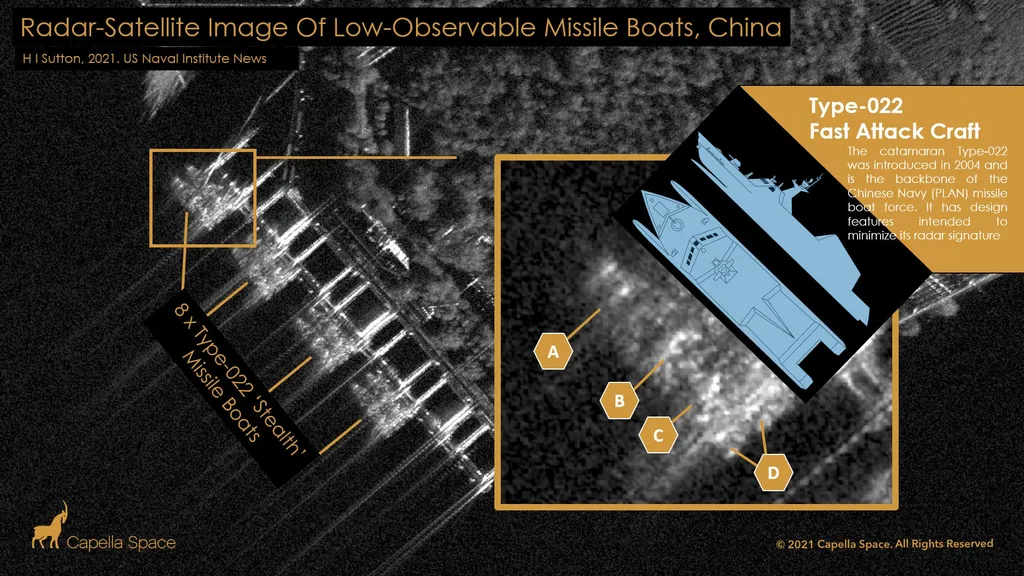
In a significant stride towards enhancing maritime surveillance and safety, researchers have developed a novel, lightweight model for ship detection using synthetic aperture radar (SAR) images. This innovation, dubbed LSDFormer, is the brainchild of Rui Jiang and colleagues from the College of Information Engineering at Shanghai Maritime University. The model addresses longstanding challenges in SAR ship detection, such as strong background interference, varying ship appearances, and the need for real-time processing.
So, what’s the big deal? Well, imagine trying to spot ships in a radar image where the background noise is almost as loud as the ships themselves. Traditional methods often struggle with this, but LSDFormer uses a clever combination of attention mechanisms to enhance ship features and suppress that pesky background interference. It’s like having a super-powered spotlight that illuminates the ships while dimming the surrounding clutter.
The model’s secret sauce lies in its efficient multiattention mechanism, which integrates three types of attention: a PoolFormer-based feature extraction module with efficient channel modulation attention, a downsampling module using efficient channel aggregation attention and group convolutions, and position-sensitive attention from YOLOv11. This trio works together to enrich ship features and handle variations in ship appearance and distribution.
But here’s where it gets really interesting. The researchers also introduced a structural reparameterization (SR)-enhanced head, which boosts ship features while keeping the model’s complexity in check. This means LSDFormer can deliver high performance without requiring massive computational resources. As Jiang puts it, “Our model achieves a remarkable balance between accuracy and efficiency, making it suitable for real-time applications.”
And real-time is the name of the game in maritime operations. Whether it’s avoiding collisions, monitoring traffic, or conducting search and rescue missions, the ability to process and analyze radar images swiftly and accurately can be a game-changer. LSDFormer’s impressive performance metrics speak for themselves: it achieved an average precision of 98.5% on the SSDD dataset and 92.8% on the HRSID dataset, with only 1.5 million parameters and 4.1 GFLOPs. That’s some serious horsepower under the hood.
For the maritime industry, the implications are vast. From enhancing vessel traffic management to improving maritime security and environmental monitoring, LSDFormer’s capabilities can significantly bolster operational efficiency and safety. Moreover, its lightweight nature makes it ideal for deployment on resource-constrained platforms, such as drones or small vessels, opening up new avenues for innovation.
The research was recently published in the IEEE Journal of Selected Topics in Applied Earth Observations and Remote Sensing, a prestigious forum for cutting-edge work in remote sensing technologies. As the maritime sector continues to embrace digital transformation, advancements like LSDFormer are set to play a pivotal role in shaping the future of maritime operations. So, buckle up, folks—the future of ship detection is here, and it’s looking mighty impressive.