
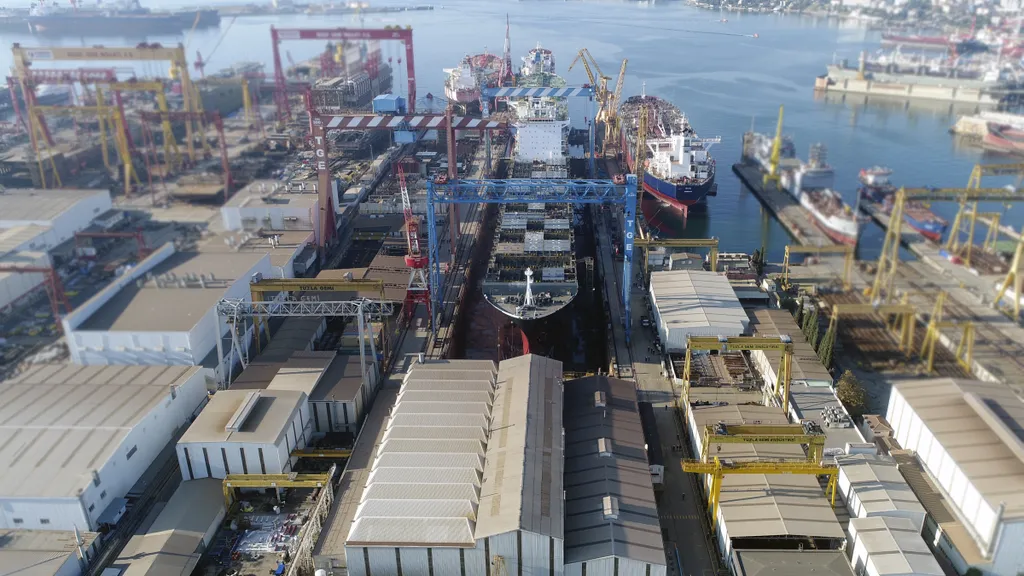
In a bid to tackle the shipbuilding industry’s substantial carbon footprint, a recent study published in the ‘Journal of Eta Maritime Science’ (translated as ‘Journal of Alpha Maritime Science’) has shed light on the emissions landscape of a Turkish shipyard. The research, led by Enes Tekelli from İstanbul Technical University’s Department of Shipbuilding and Ocean Engineering, offers a comprehensive assessment of the carbon emissions generated during the manufacturing of tugboats, with a keen eye on potential reduction strategies.
The study, which focuses on Scope I, II, and III emissions as defined by the Greenhouse Gas (GHG) Protocol, reveals that the shipyard’s overall emissions are predominantly Scope I (55.68%), followed by Scope III (27.51%) and Scope II (16.81%). Scope I emissions are direct emissions from owned or controlled sources, Scope II are indirect emissions from the generation of purchased energy, and Scope III are all other indirect emissions.
Tekelli and his team utilized the DEFRA 2023 emission coefficients to calculate CO2 equivalent emissions for each activity type, providing a clear picture of the shipyard’s environmental impact. The research underscores the urgency of reducing these emissions, stating, “The carbon footprint evaluation emphasizes the necessity of diminishing it and underscores the significance of prioritizing environmental sustainability.”
The study explores several strategies to mitigate the environmental impact of carbon emissions in the shipbuilding industry. These include the adoption of solar energy, a transition to electric vehicles, the implementation of a hybrid work model, and the establishment of local supply networks. Tekelli highlights, “These strategies provide practical and sustainable approaches to mitigating the environmental impact of carbon emissions in the shipbuilding industry.”
For maritime professionals, the study presents both challenges and opportunities. The need to reduce emissions is clear, but the path to decarbonization is not without its hurdles. However, the strategies proposed offer a roadmap for shipyards to reduce their carbon footprint, potentially leading to cost savings and improved environmental performance.
Moreover, the shift towards sustainability can open up new commercial opportunities. Shipyards that can demonstrate a commitment to reducing emissions may find themselves at an advantage in an increasingly eco-conscious market. The establishment of local supply networks, for instance, could not only reduce emissions but also stimulate local economies and foster innovation.
In conclusion, Tekelli’s research serves as a timely reminder of the shipbuilding industry’s role in the global effort to mitigate climate change. By embracing the strategies outlined in the study, shipyards can take significant steps towards reducing their carbon footprint and contributing to a more sustainable future. As the maritime industry continues to evolve, the insights from this research will be invaluable in guiding the sector towards a greener, more sustainable future.