
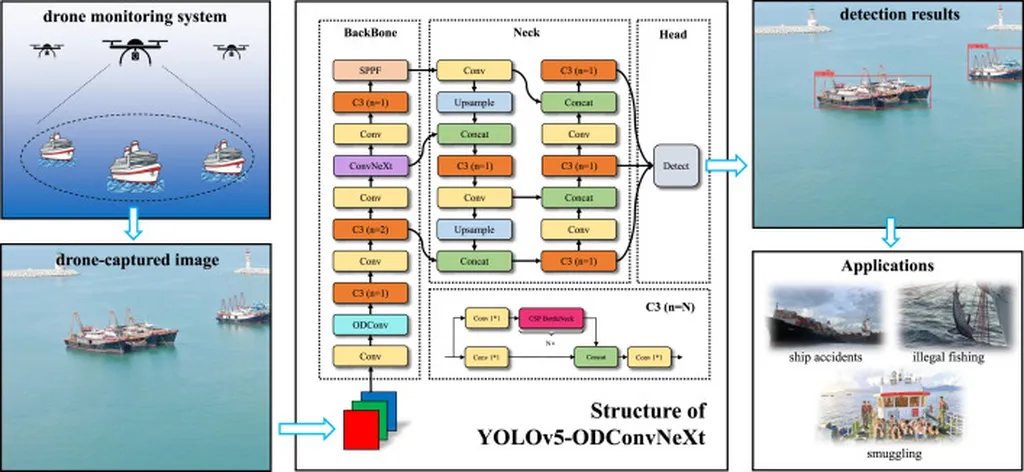
In a significant stride towards enhancing maritime surveillance and environmental monitoring, a team of researchers led by S. Das from the Institute of Environment Education and Research at Bharati Vidyapeeth University in Pune, India, has developed advanced deep learning models to improve ship detection using high-resolution satellite and SAR (Synthetic Aperture Radar) imagery. The study, published in the ‘ISPRS Annals of the Photogrammetry, Remote Sensing and Spatial Information Sciences’ (International Society for Photogrammetry and Remote Sensing), focuses on overcoming challenges such as class imbalance, environmental fluctuations, and the need for real-time applications.
The research team tested two deep learning models, YOLOv8 and Mask R-CNN, using a dataset of 1000 high-resolution images and SAR data from Mumbai and Chennai, chosen for their diverse marine environments. YOLOv8, known for its real-time object detection capabilities, classified ships into 15 categories, while Mask R-CNN provided segmentation of the detected ships. The models were evaluated based on metrics such as recall, precision, and mean average precision.
One of the key findings was that YOLOv8 outperformed Mask R-CNN in real-time applications, with a precision of 52.8%, recall of 41.9%, and a mean average precision (mAP) of 44.2% at 50% intersection over union (IoU) threshold. “YOLOv8 can detect ships in real time, making it a feasible tool for port surveillance and marine traffic monitoring,” said lead author S. Das. The integration of SAR data further enhanced detection accuracy across various environmental conditions.
The study also highlighted that while the models performed well with larger vessels like oil tankers and cruise ships, smaller objects such as rafts and dinghies posed more challenges. “Feeble or partially visible vessels are still difficult to detect,” noted the researchers. To address these issues, the team employed data augmentation techniques and loss functions like binary cross-entropy and Dice coefficient, achieving a Dice Coefficient of 0.86, precision of 89%, and recall of 82%.
The commercial implications of this research are substantial. Enhanced ship detection capabilities can significantly improve maritime navigation, monitoring of illicit activities, and environmental preservation. Port authorities and marine traffic monitoring systems can leverage these advanced models to ensure safer and more efficient operations. Additionally, the ability to detect ships in real-time can be crucial for national security and disaster response.
Looking ahead, the researchers suggest that future work should focus on extending datasets, refining model architectures, and exploring more sophisticated deep learning approaches. “To overcome maritime object detection issues, future research should extend datasets, refine model architectures, and use advanced deep learning approaches,” the team concluded.
This groundbreaking research not only advances the field of maritime surveillance but also opens up new opportunities for the maritime sector to enhance its operational efficiency and safety measures. As the technology continues to evolve, the integration of deep learning models like YOLOv8 and Mask R-CNN into maritime systems could become a standard practice, revolutionizing how we monitor and manage our oceans.