
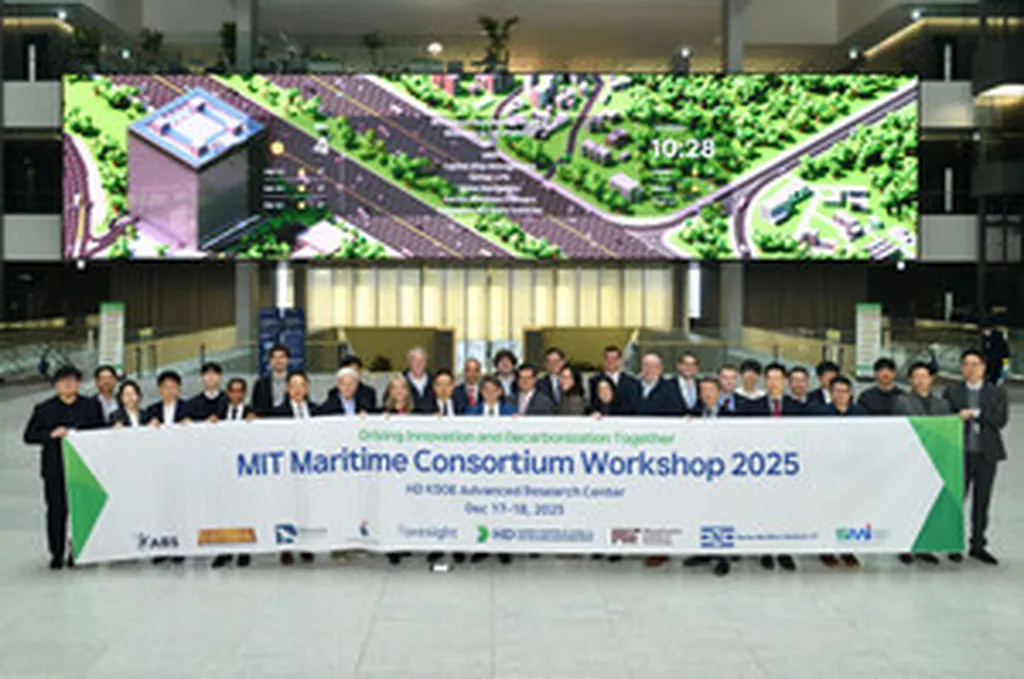
HD Korea Shipbuilding & Offshore Engineering has unveiled its “shipbuilding technology roadmap” and the first-year research outcomes from the MIT-led maritime consortium, spotlighting advancements in autonomous navigation, cybersecurity, and small modular reactor (SMR) research. The company hosted a workshop at the HD Hyundai Global R&D Center in Seongnam, south of Seoul, to share these breakthroughs with about 180 participants, including consortium members and industry and academic experts.
The MIT Maritime Consortium, launched in March, is a collaborative effort led by the Massachusetts Institute of Technology, Greek shipping company Capital, and the American Bureau of Shipping. Its mission is to drive innovation and decarbonization in the maritime industry. HD Korea Shipbuilding highlighted several key achievements from the consortium’s first year, including AI-based autonomous navigation solutions, cybersecurity advancements, and the development of SMR-powered vessels and 3D printing technologies.
One of the standout developments is the consortium’s plan to install Avikus’ “HiNAS Control” autonomous navigation system on selected vessels. This system, developed by HD Hyundai’s autonomy subsidiary, aims to verify potential fuel-efficiency gains. Additionally, a prototype AI model for detecting cyber threats has been developed, enhancing the security of maritime operations.
The consortium also contributed to the production of an “SMR Propulsion Ship Safety Handbook,” published by MIT in October. This handbook is a significant step toward establishing standards for the commercialization of marine nuclear technology.
Jang Kwang-pil, head of the Future Technology Research Institute at HD Korea Shipbuilding & Offshore Engineering, emphasized the company’s commitment to expanding consortium R&D efforts. He stated, “The company will expand consortium R&D efforts, including establishing standards to verify fuel savings from AI-integrated autonomous navigation solutions. We aim to contribute to technological innovation and decarbonization through global cooperation in shipbuilding.”
HD Hyundai is broadening its cooperation with overseas universities beyond MIT. In July, the company signed an education cooperation memorandum with the University of Michigan and Seoul National University to foster shipbuilding talent. Additionally, it hosted a Korea-U.S. shipbuilding cooperation expert forum at its Seongnam R&D Center in June.
These initiatives underscore HD Hyundai’s strategic focus on leveraging cutting-edge technology and global partnerships to drive innovation and sustainability in the maritime industry. By integrating AI, cybersecurity, and advanced propulsion technologies, the company is positioning itself at the forefront of the energy transition and digital transformation in shipbuilding.