
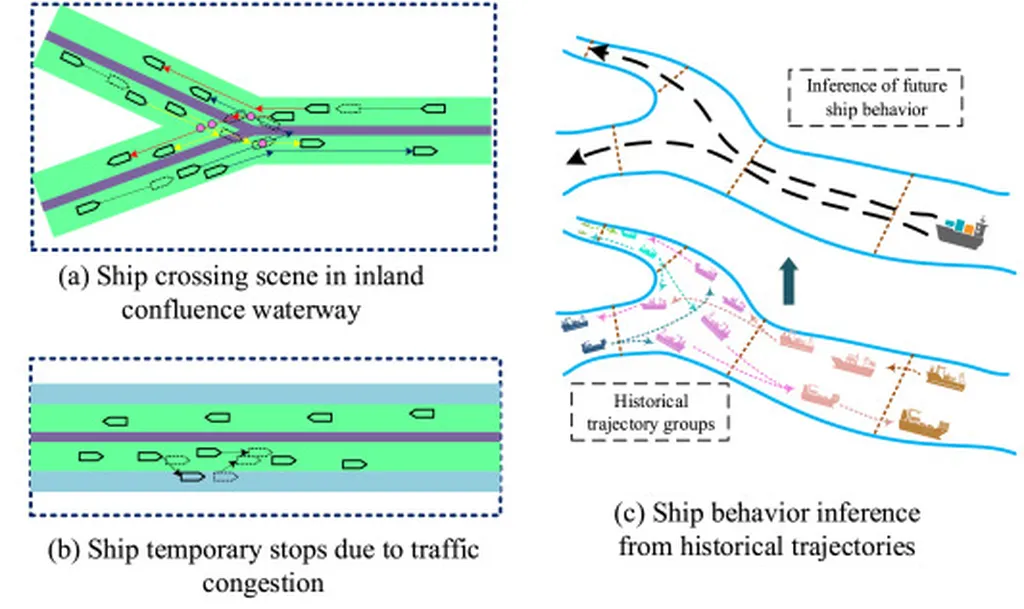
In the ever-evolving world of maritime traffic management, a groundbreaking study has emerged that promises to revolutionize how we predict and manage vessel movements. Led by Zhao Liu from the School of Navigation at Wuhan University of Technology in China, this research introduces an innovative model that leverages ensembles of decision trees to predict traffic patterns using Automatic Identification System (AIS) data. Published in the ‘IET Intelligent Transport Systems’ journal, the study offers a fresh perspective on inland waterway traffic management, particularly in complex environments like the Fujiangsha waters of the Jiangsu section of the Yangtze River.
So, what’s the big deal? Well, imagine having a tool that can accurately forecast navigation routes, infer ship behavior, and support intelligent ship navigation. That’s precisely what Liu’s model aims to achieve. By integrating static information—such as a ship’s origin and destination—with dynamic data like speed, course, and spatial position, the model extracts relevant traffic features. These features are then fed into a stacked predictive framework, combining traditional algorithms with a decision tree ensemble model.
The results are impressive. The model consistently outperforms traditional algorithms and other ensemble models, maintaining an accuracy rate above 98% across diverse scenarios. Testing on unseen ship data further confirms its reliability, aligning well with actual navigation patterns. “This model has strong potential to forecast navigation routes for improved traffic management, infer ship behavior based on predicted traffic patterns, and support future applications in intelligent ship navigation,” says Liu.
For maritime professionals, the implications are significant. Accurate traffic pattern prediction can lead to more efficient traffic management, reducing the risk of collisions and improving overall safety. It can also optimize route planning, saving time and fuel costs. Moreover, the ability to infer ship behavior based on predicted traffic patterns opens up new avenues for proactive decision-making and risk assessment.
The commercial impacts are equally compelling. Port authorities and shipping companies can use this model to enhance their operational efficiency and safety standards. The maritime industry, which has always been data-driven, now has a powerful tool to leverage AIS data more effectively. This could lead to increased investment in intelligent navigation systems and advanced traffic management solutions.
In the words of Liu, “The findings suggest that this model has strong potential to forecast navigation routes for improved traffic management, infer ship behavior based on predicted traffic patterns, and support future applications in intelligent ship navigation.” This is not just about predicting where ships will go; it’s about understanding why they go there and how we can optimize their journeys.
As the maritime industry continues to evolve, embracing such technological advancements will be crucial. The model developed by Zhao Liu and his team is a testament to the power of data and machine learning in transforming maritime traffic management. It’s a step towards a future where navigation is not just about getting from point A to point B, but doing so in the most efficient, safe, and intelligent way possible.