
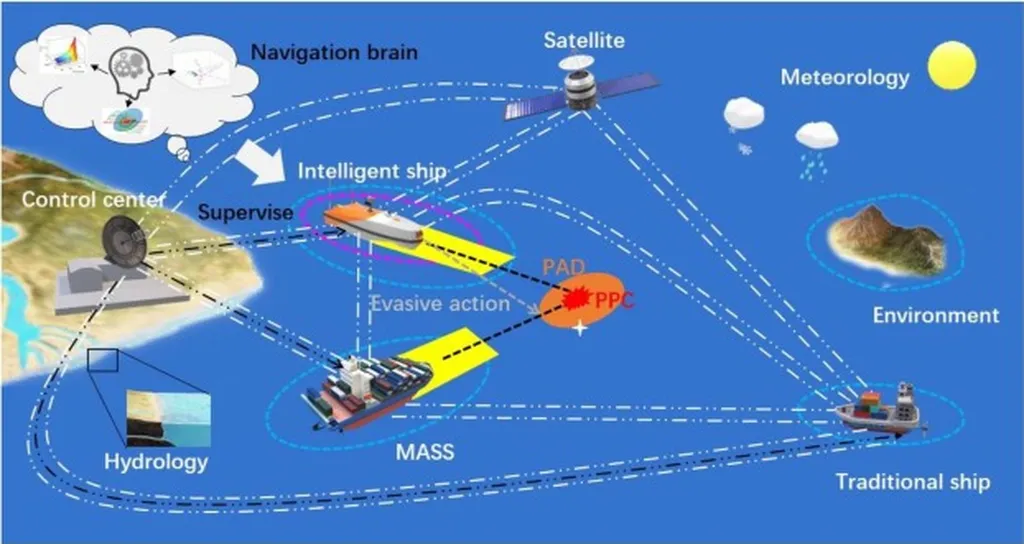
In the ever-evolving world of maritime technology, a novel approach to collision avoidance has emerged, promising to revolutionize how ships navigate and interact at sea. Researchers, led by Yang Wang from the State Key Laboratory of Maritime Technology and Safety at Wuhan University of Technology in China, have proposed a distributed multi-ship collision avoidance (CA) scheme that leverages autonomous decision-making and route exchange. This innovative strategy, published in the IET Intelligent Transport Systems journal (which translates to the Intelligent Transport Systems journal of the Institution of Engineering and Technology), aims to enhance safety and efficiency in maritime navigation.
The proposed scheme is designed to address the dynamic and autonomous nature of real-world maritime scenarios. By allowing ships to share their decisions or intentions through route exchange, the system enables each vessel to make subsequent decisions based on the route planning of others. This iterative process transforms the multi-ship collision avoidance problem into a staged cooperative game under complete information conditions.
One of the key innovations in this research is the introduction of the concept of closest spatio-temporal distance (CSTD). This metric provides a more accurate assessment of collision risk between ships, allowing for more precise and timely avoidance maneuvers. When a collision risk is identified, a coordinated CA mechanism is activated. This mechanism incorporates various factors, including stand-on/give-way relationships, negotiation rounds, route re-planning calculations, and cost factors for route evaluation.
The researchers have employed the Nash bargaining solution (NBS) to achieve Pareto-optimal CA routes in the scenarios. This approach ensures that while the individual interests of each ship are maximized, the economic fairness and global optimization of the overall system are also maintained. As Yang Wang explains, “The NBS shows good flexibility and adaptability, and when all ships comply with route re-planning solution, the proposed scheme can bring out normal solutions within a limited number of re-planning iterations.”
The commercial impacts and opportunities for the maritime sectors are substantial. Enhanced collision avoidance capabilities can lead to increased safety at sea, reducing the risk of accidents and the associated costs. Moreover, the efficient route planning and negotiation process can optimize fuel consumption and reduce travel time, leading to significant economic benefits for shipping companies.
The adaptability of the proposed scheme makes it suitable for a wide range of maritime applications, from commercial shipping to naval operations. As the maritime industry continues to embrace autonomous technologies, this research provides a robust framework for ensuring safe and efficient navigation in increasingly complex and dynamic environments.
In summary, the research led by Yang Wang offers a promising advancement in maritime collision avoidance. By integrating autonomous decision-making, route exchange, and game theory, the proposed scheme enhances safety, efficiency, and economic fairness in maritime navigation. As the industry continues to evolve, such innovations will play a crucial role in shaping the future of maritime operations.