
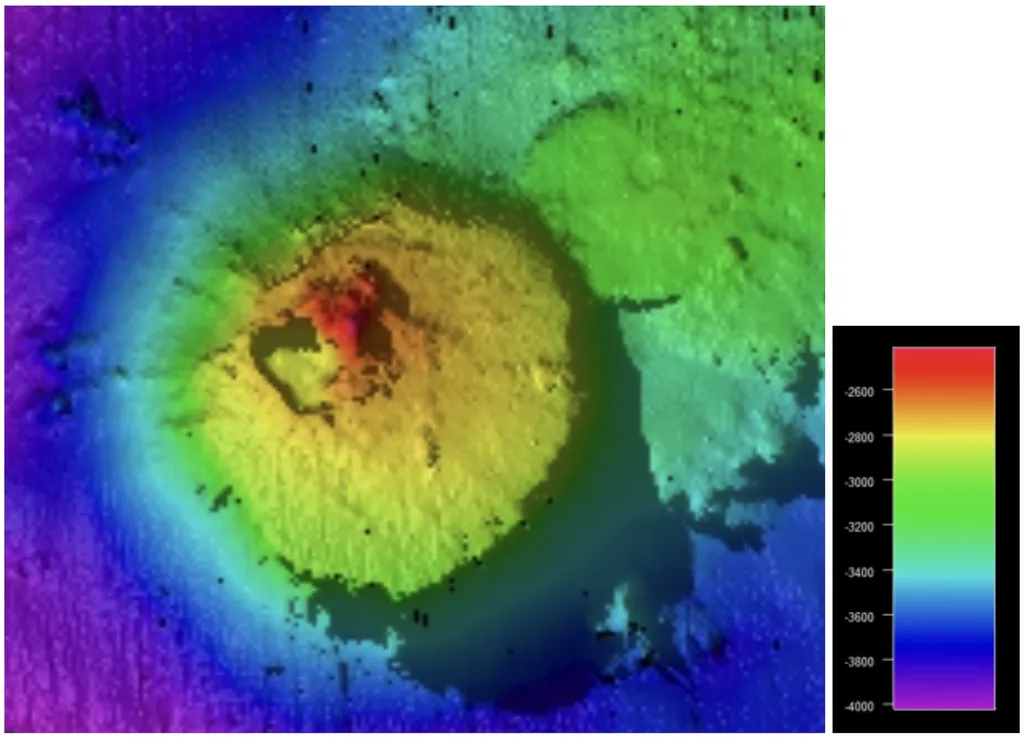
The Schmidt Ocean Institute has made significant strides in advancing seafloor mapping capabilities, announcing it has mapped two million square kilometers of seafloor—an area roughly the size of Greenland. This milestone is part of a broader effort to enhance the mapping prowess of the R/V Falkor (too), the institute’s flagship research vessel. Two key modifications have been made to achieve this: a redesign of the ship’s bow and the addition of an Autonomous Underwater Vehicle (AUV).
Over a two-month dry dock period from April 28 to June 28 in Talcahuano, Chile, the team reconstructed the bow of the R/V Falkor (too). The transformation involved changing the bulbous bow, commonly found on commercial vessels, to a streamlined, V-shaped bow optimized for scientific missions. This redesign enhances the precision and reliability of the ship’s sonar systems, allowing for high-quality mapping data even in challenging weather conditions. The new bow can now capture high-resolution data at speeds of 6-11 knots (~7-13 mph) and in swells exceeding three meters.
The redesigned bow also helps eliminate bubbles that previously interfered with the ship’s sonars and sensors. This improvement addresses a challenge posed by the original MV Polar Queen vessel design, which was optimized for faster transits rather than detailed seafloor mapping. Seafloor maps are created using multibeam sonar technology, which sends sound from the vessel to the seafloor. Scientists, particularly hydrographers, use the time it takes for the sound to travel between the ship and the seafloor to calculate depth, creating bathymetric maps that reveal features like underwater mountains and canyons.
In addition to the bow redesign, the Schmidt Ocean Institute has added the Kongsberg Hugin Superior AUV, named The Childlike Empress, to its technology suite. This advanced AUV can operate at depths of up to 6,000 meters and stay in the water for up to 72 hours, offering access to 98% of the ocean floor, with the exception of the deepest trenches. The institute’s ROV SuBastian can operate in waters up to 4,500 meters. The AUV, which is the most adaptable and advanced commercially available vehicle, will be mission-ready by mid-2026 after additional training and field tests.
The AUV is equipped with a variety of sonars and sensors, including a traditional multibeam system, sub-bottom profiler, magnetometer, oxygen, methane, and dissolved carbon dioxide sensors, a conductivity, temperature, depth (CTD) sensor, imaging system, and Synthetic Aperture Sonar (SAS). While multibeam systems collect data at resolutions of 1-50 meters depending on the depth and type of sonar, SAS can collect data every 25 centimeters (2 feet), achieving much higher resolution and producing some of the clearest seafloor images. These maps help pinpoint the exact locations of hydrothermal vents, shipwrecks, and other interesting seafloor features. The AUV can also house additional sensors and imaging equipment, making it highly adaptable to the needs of scientists.
Seafloor mapping is critical for improving our understanding of ocean ecosystems, resource management, safe navigation, and more. Despite these advancements, just over 70% of the ocean floor remains unmapped. The Schmidt Ocean Institute’s efforts are a significant step toward filling this knowledge gap and advancing our understanding of the deep sea.
“This is a game-changer for marine research,” said Jason Williams, Engineering Senior Manager at the Schmidt Ocean Institute. “The new bow design and the addition of The Childlike Empress AUV will allow us to map the seafloor with unprecedented precision and detail. These advancements will not only enhance our scientific capabilities but also contribute to global efforts in ocean conservation and sustainable resource management.”
The Schmidt Ocean Institute’s latest enhancements to the R/V Falkor (too) represent a significant leap forward in marine research technology. By improving the ship’s mapping capabilities and integrating cutting-edge AUV technology, the institute is poised to make groundbreaking discoveries that will deepen our understanding of the ocean floor and its ecosystems.