
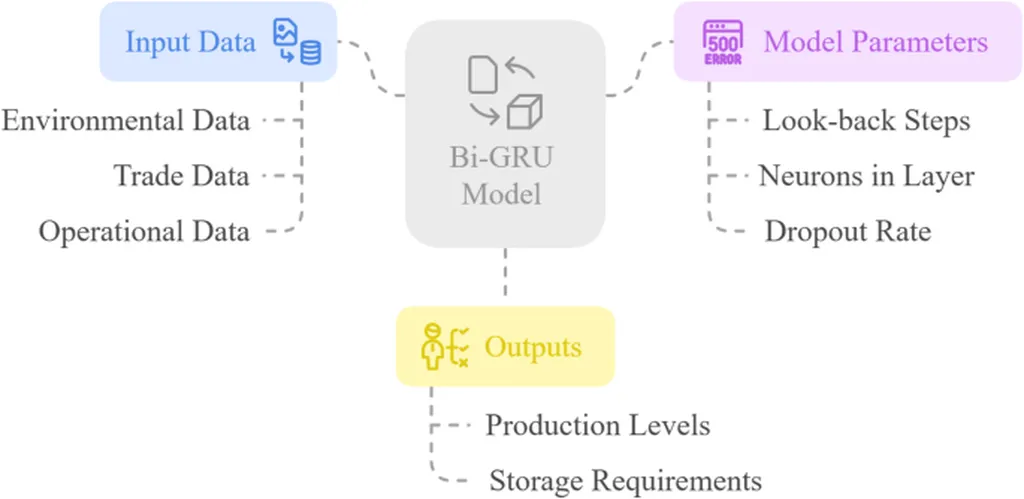
In a significant stride towards sustainable supply chain management, researchers have developed a hybrid framework that combines advanced AI techniques to tackle the multifaceted challenges faced by the agricultural and food supply chain. The study, led by Zhenjie Li from Monash University and published in the journal Scientific Reports, introduces a novel approach that merges Bidirectional Gated Recurrent Unit (Bi-GRU) networks with a Hybrid Maritime Search and Rescue (HMSR) algorithm.
The agricultural and food supply chain is no stranger to disruptions, from unpredictable weather events to transportation delays. Traditional methods often fall short in addressing these dynamic disturbances due to their lack of adaptability and scalability. Enter Li’s team, who propose a solution that not only predicts production and storage needs but also optimizes decisions based on various constraints.
The Bi-GRU model, a type of recurrent neural network, is fed data from IoT sensors and market trends to predict production and storage requirements. Meanwhile, the HMSR algorithm steps in to optimize these decisions, considering factors like production capacity, storage constraints, and market demand. The result? A framework that reduces waste by 34.2%, maximizes profit margins by 28.7%, and achieves 92.4% accuracy in making storage decisions.
So, what does this mean for the maritime sector? Well, the maritime industry plays a pivotal role in global supply chains, and this research offers a glimpse into how AI-driven approaches can revolutionize the way we manage and optimize these complex networks. By reducing waste and maximizing profits, this framework could lead to more efficient and sustainable maritime logistics operations.
Moreover, the integration of IoT sensors and AI-driven predictive analytics opens up opportunities for real-time monitoring and decision-making. This could be a game-changer for maritime professionals, enabling them to anticipate and respond to disruptions more effectively.
As Li puts it, “Hybrid AI-driven approaches can revolutionize agricultural structures and food supply chains, providing adaptable and scalable solutions for institutions in their pursuit of profitability and sustainability.” And it’s not just about agriculture. The principles and technologies underpinning this research could be applied to a wide range of maritime sectors, from fishing and aquaculture to shipping and port management.
In an era where sustainability and efficiency are paramount, this research offers a promising path forward. By embracing AI and IoT technologies, the maritime industry can strive towards more resilient, profitable, and sustainable supply chains.