
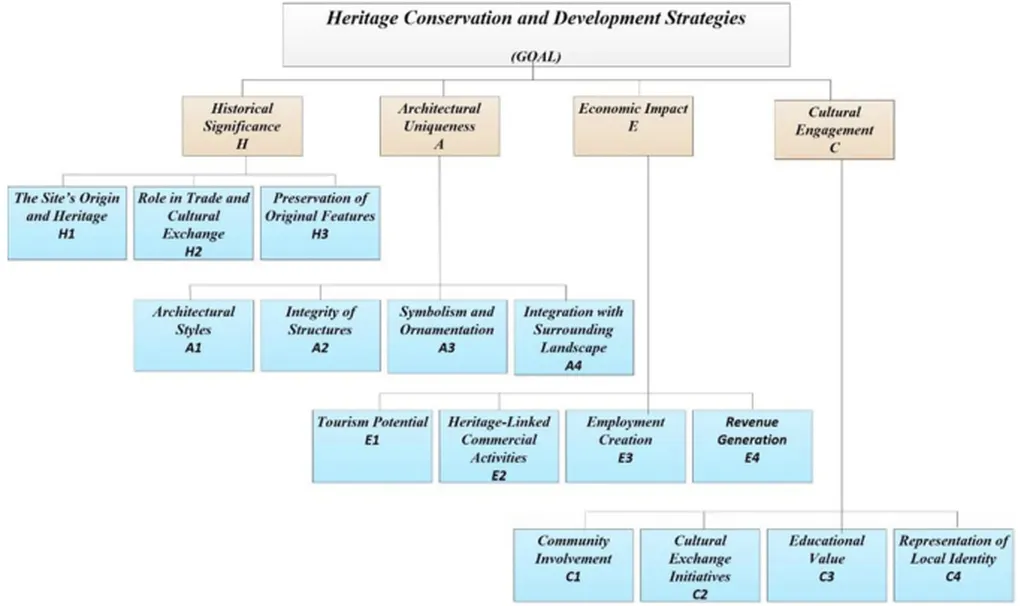
In a groundbreaking study, researchers have turned to a sophisticated decision-making tool to tackle the age-old challenge of preserving historic ports. The research, led by Fowzia Akter from the School of Art and Design at Wuhan University of Technology, applies the AHP-TOPSIS multi-criteria decision-making (MCDM) method to evaluate and compare heritage conservation strategies for historic ports in the UK, Spain, and China. The ports under the microscope are Liverpool, Cádiz, and Quanzhou, each with a rich maritime history and a unique set of modern-day challenges.
So, what’s AHP-TOPSIS, you ask? It’s a fancy way of saying that the researchers combined expert opinions with quantitative analysis to weigh up different factors. They looked at four main criteria: historical significance, architectural integrity, economic impact, and cultural engagement. Each of these was further broken down into sub-criteria, all given different weights based on their importance.
The results, published in the journal ‘Humanities & Social Sciences Communications’ (which, in plain English, is a journal that covers humanities and social sciences), show that there’s no one-size-fits-all approach to port conservation. Instead, local policies and socio-cultural contexts play a significant role in shaping conservation practices.
For maritime professionals, this research offers a valuable framework for decision-making. As Akter puts it, “This research provides an AHP-TOPSIS based framework for decision-makers who work in heritage conservation and which can be used as part in the sustainability of urban development.” In other words, it’s a tool that can help balance the need to preserve our maritime heritage with the demands of modern urban development.
The commercial impacts and opportunities are significant. Historic ports are not just relics of the past; they’re often key drivers of local economies. By carefully managing the adaptive reuse of these areas, cities can attract tourists, create jobs, and stimulate economic growth. But it’s a delicate balancing act. Over-commercialization can lead to the loss of historic character, while under-utilization can result in decay and economic stagnation.
This research offers a way to navigate these challenges. By providing a structured approach to decision-making, it can help cities make the most of their maritime heritage, ensuring that these historic ports continue to play a vital role in our communities and economies.
In the words of the researchers, “This study seeks to make a comparative assessment of the adaptive reuse potential of port heritage areas through combining expert opinions and quantitative analysis.” It’s a reminder that our maritime heritage is a valuable asset, and with the right tools and approaches, we can ensure that it continues to thrive for generations to come.