
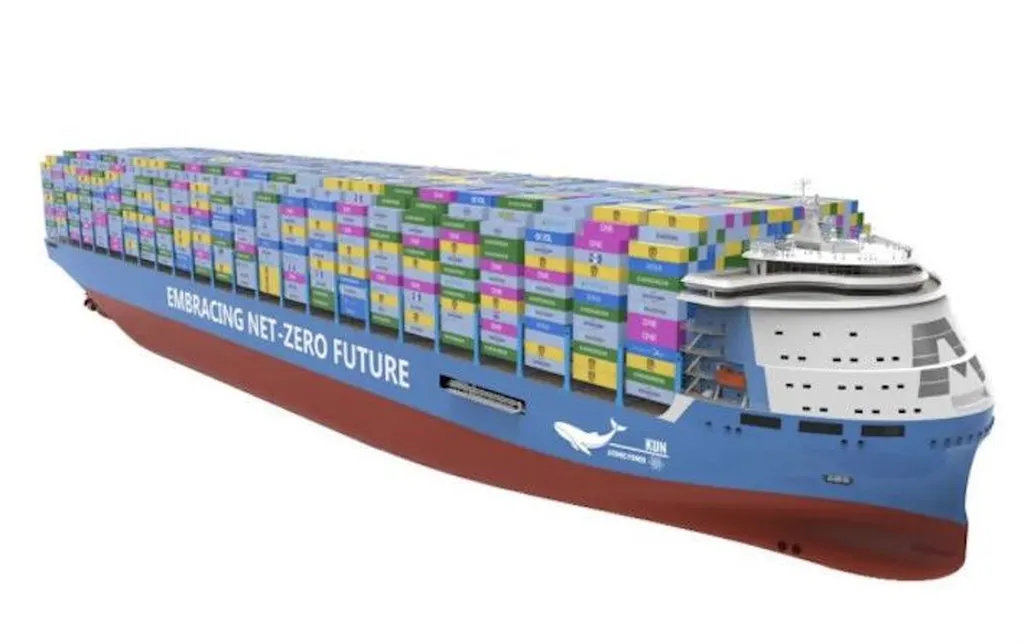
The maritime industry is increasingly turning to nuclear propulsion as a viable option for achieving net-zero emissions, with a growing number of stakeholders engaging with the technology in 2025. This shift is driven by the potential of fourth-generation Small Modular Reactors (SMRs), which offer a promising solution for commercial shipping.
Class societies such as Lloyd’s Register, ABS, and RINA have already expressed their support for nuclear propulsion. In a significant development, Samsung Heavy Industries (SHI) and the Korea Atomic Energy Research Institute (KAERI) unveiled an SMR-powered LNG carrier concept in collaboration with ABS and the Liberia flag. This concept features a 100 MWt molten salt reactor designed to power the ship throughout its lifecycle without the need for refueling.
The interest in nuclear propulsion is not confined to shipbuilders and regulators. Financiers, owners, consultants, and insurers are also actively discussing the technology at various industry events. Markus Virtasalo, Solution Manager, Electric Solutions, ABB’s Marine & Ports division, highlights the intense behind-the-scenes work to make nuclear propulsion a realistic option for commercial shipping. He notes that while interest is high, the process involves extensive collaboration and documentation, making it a marathon rather than a sprint.
ABB is at the forefront of this development, working closely with stakeholders to harness its expertise in power distribution, control, automation, and system integration. The company has signed a memorandum of understanding (MoU) with Swedish nuclear energy company Blykalla to support the deployment of small modular lead-cooled reactors in the maritime industry. Blykalla’s Swedish Advanced Lead Reactor (SEALER) is a compact, passively safe reactor with inherent safety features, making it a strong candidate for maritime applications.
Samuli Hänninen, Segment Manager for Icebreaking ships at ABB’s Marine & Ports division, emphasizes the importance of collaboration in realizing the vision of maritime nuclear propulsion. He notes that ABB’s expertise in naval architecture and marine engineering, combined with Blykalla’s reactor technology, can provide the certainty needed to accelerate development in this application.
The regulatory landscape for nuclear-powered ships is also evolving. In June 2025, the IMO’s Maritime Safety Committee (MSC110) agreed to update legacy regulations governing nuclear-powered ships, tasking the Sub-Committee on Ship Design and Construction (SDC) to develop a framework for integrating nuclear propulsion into the mix to achieve net-zero emissions by around 2050. The IMO also granted NGO status to the Nuclear Energy Maritime Organization (NEMO), which includes members such as shipowners, shipyards, classification societies, insurers, legal companies, and port authorities.
As the maritime industry navigates the complexities of transitioning to net-zero emissions, nuclear propulsion offers a promising solution. The collaboration between ABB and Blykalla, along with the support of class societies and regulators, indicates a strong commitment to exploring and implementing this technology. While the process is complex and time-consuming, the potential benefits of zero-emission shipping make it a marathon worth running.