
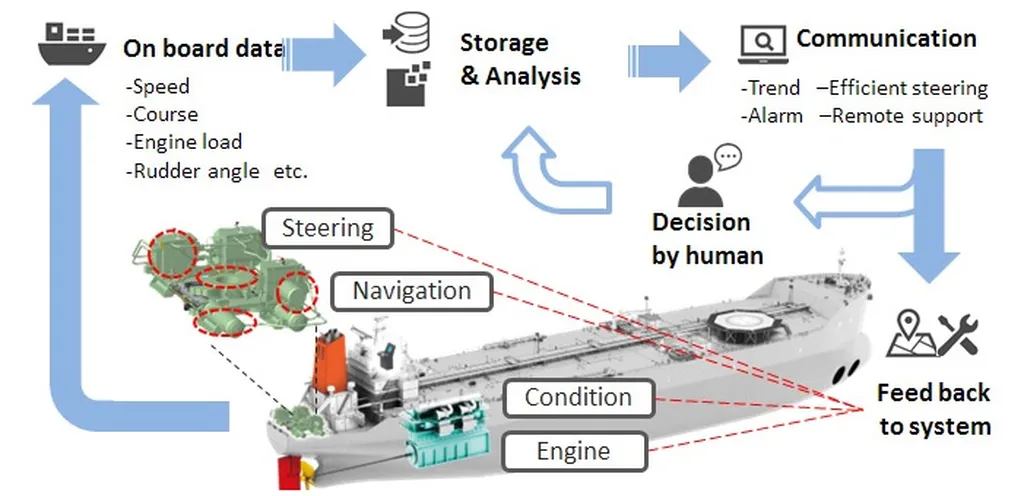
In the ever-evolving world of maritime technology, a recent study published in the journal *China Shipbuilding Research* (translated from *Zhongguo Jianchuan Yanjiu*) has shed light on a novel approach to ship course-keeping control. Led by Liuhua Yu from the Shanghai Shipbuilding Technology Research Institute, the research introduces an adaptive-gain sliding mode control system that promises to enhance the precision and stability of ship heading maintenance.
So, what does this mean for the maritime industry? Imagine a ship navigating through choppy waters, its course kept steady and true, thanks to a control system that adapts in real-time to changing conditions. This is the promise of Yu’s research. The study describes a system that uses a high-gain adaptive observer to quantify state signals, effectively minimizing course-keeping errors and ensuring the ship stays on track.
Yu explains, “The quantized adaptive sliding mode controller is designed based on a high-gain observer and logarithmic quantizer.” This means the system can handle the complexities of real-world conditions, where factors like wind, waves, and currents can throw a ship off course. By quantizing the input and output signals, the system can better manage these variables, leading to more accurate course-keeping.
The commercial impacts of this technology are significant. For shipping companies, improved course-keeping means more efficient voyages, reduced fuel consumption, and lower operational costs. In an industry where margins can be tight, even small improvements in efficiency can translate to substantial savings.
Moreover, the stability and precision offered by this control system can enhance safety at sea. Ships that maintain their course more accurately are less likely to encounter hazardous situations, reducing the risk of accidents and the associated costs.
Yu’s research also highlights the potential for this technology to be integrated into existing ship control systems. The study’s findings suggest that the designed observer effectively evaluates relevant parameters of ship heading and yaw angular velocity, ensuring the closed-loop control system remains stable.
For maritime professionals, this research opens up new avenues for innovation. The adaptive-gain sliding mode control system could be a game-changer for ship design and operation, offering a robust solution to the challenges of course-keeping in varied maritime conditions.
As the maritime industry continues to evolve, technologies like this will play a crucial role in shaping the future of shipping. Yu’s work, published in *China Shipbuilding Research*, provides a valuable reference for those looking to harness the power of intelligent control systems in the maritime sector.