
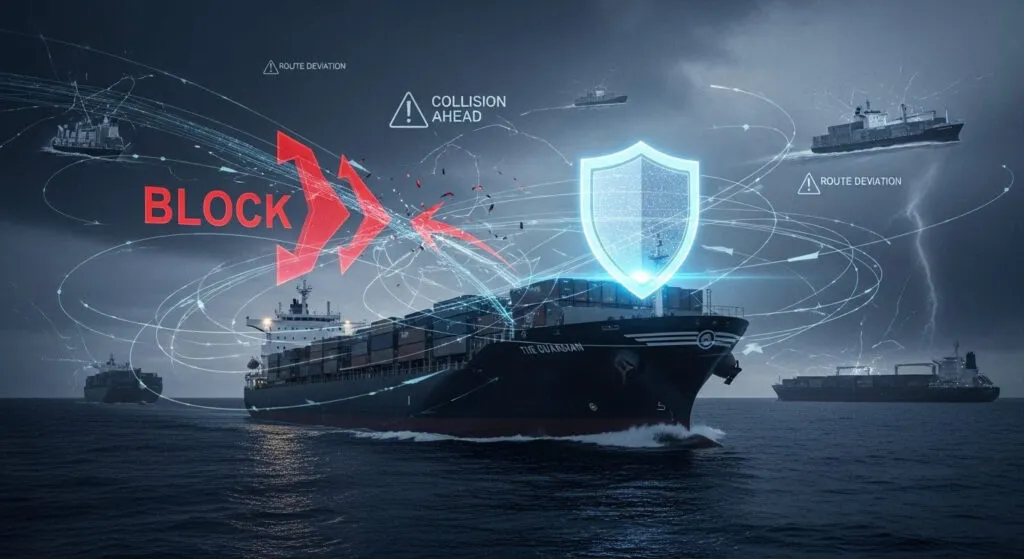
In a significant stride towards bolstering maritime security, researchers have developed a comprehensive framework to detect and respond to GPS spoofing attacks on autonomous ships. The study, led by Ines Agrebi from the Department of Electrical and Computer Engineering at the University of Victoria, Canada, addresses a critical threat to maritime autonomous surface ships (MASS), which rely heavily on GPS for navigation and situational awareness.
GPS spoofing, a form of cyberattack where false signals are transmitted to deceive GPS receivers, can lead to catastrophic consequences, including collisions and grounding. Agrebi and her team tackled this issue by creating a modular simulation of various spoofing attacks, including ghost vessels, gradual drift, location jumps, replay, and meaconing. They then merged these spoofed AIS (Automatic Identification System) points with normal data to generate a synthetic dataset, providing a ground-truth resource for model training and evaluation.
The team evaluated several machine learning models, with a GRU-based (Gated Recurrent Unit) approach emerging as the top performer. This model achieved an impressive F1-score of 0.98, demonstrating high accuracy and reliability. The framework also includes an automated response module that applies debouncing logic to classify suspicious events and triggers email alerts for confirmed spoofing, enabling real-time operational monitoring.
“Our framework provides a scalable and effective solution for enhancing maritime navigation security,” Agrebi stated. The integration of synthetic data generation and AI detection offers a reproducible and robust approach to combating GPS spoofing, a pressing concern for the maritime industry.
The commercial impacts of this research are substantial. As the maritime sector increasingly adopts autonomous technologies, the need for robust cybersecurity measures becomes paramount. The framework developed by Agrebi and her team can be integrated into existing systems, providing an additional layer of protection against spoofing attacks. This not only enhances safety but also builds trust in autonomous shipping technologies, potentially accelerating their adoption.
Moreover, the synthetic dataset generated by the team offers valuable opportunities for further research and development. By providing a realistic and labeled dataset, researchers and developers can refine and improve detection algorithms, fostering innovation in maritime cybersecurity.
The study, published in the IEEE Access journal, translates to “IEEE Open Access” in English, underscores the importance of interdisciplinary collaboration in addressing complex challenges. By combining expertise in electrical engineering, computer science, and maritime navigation, the team has developed a solution that has the potential to revolutionize maritime security.
As the maritime industry continues to evolve, the need for advanced cybersecurity measures will only grow. The framework developed by Agrebi and her team represents a significant step forward in this regard, offering a scalable and effective solution to a critical threat. With further research and development, the maritime sector can look forward to a future where autonomous ships navigate safely and securely, protected by cutting-edge AI technologies.