
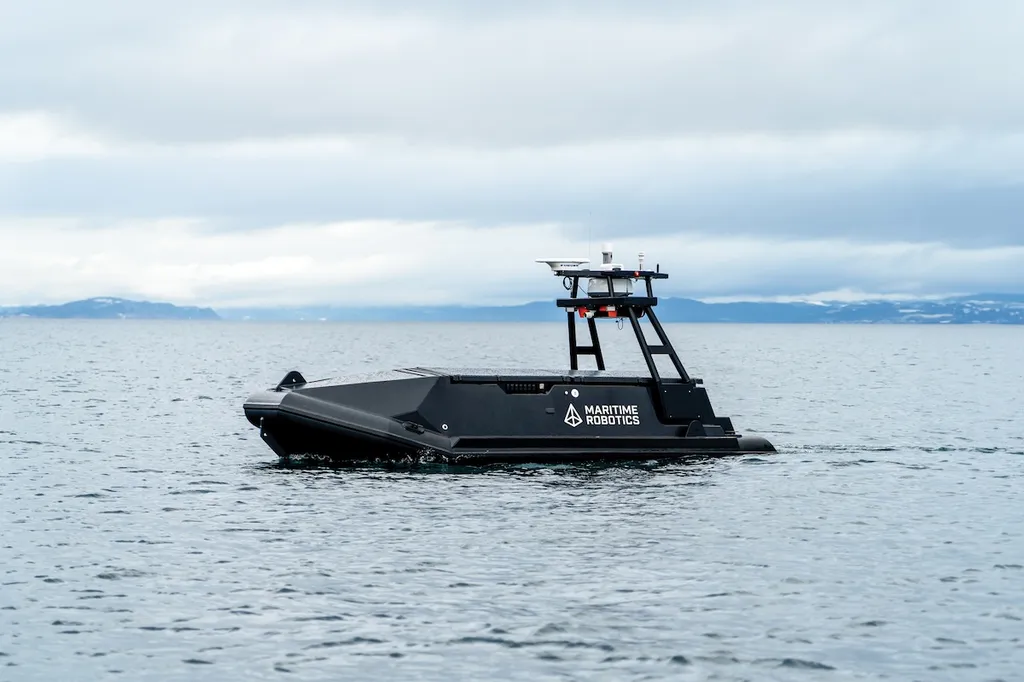
In a significant stride for maritime robotics, researchers have developed a novel approach to improve the path planning of unmanned surface vehicle (USV) swarms, leveraging the power of large language models (LLMs). This innovative method, dubbed adaptive path planning with tool-function chains (APPT), was spearheaded by Yuecheng Shi from the Key Laboratory of Marine Intelligent Equipment and System, Ministry of Education, Shanghai.
Traditionally, USV swarms have relied on passive response algorithms like A*, RRT*, APF, and DWA for path planning. However, these methods struggle in complex and dynamic marine environments due to their lack of predictive capabilities and active decision-making mechanisms. Deep reinforcement learning (DRL) approaches, while promising, come with their own set of challenges, including high training costs and weak generalization.
The APPT method, published in the journal ‘Zhongguo Jianchuan Yanjiu’ (translated to English as ‘Chinese Journal of Ship Research’), addresses these limitations by utilizing a multi-component design. It starts with a planning encoder that processes environmental data, extracting critical features like obstacle density and task constraints. This information is then converted into structured prompt vectors fed into the LLM.
The LLM-driven USV swarm path planning agent incorporates a library of classical path planning algorithms as plug-and-play “tool functions”. The LLM dynamically assembles optimal tool chains by calculating the cosine similarity between the prompt vectors and the capability feature vectors of the tool functions. Moreover, an adaptive iterative optimization mechanism, guided by user input, is implemented to adjust tool function parameters based on key evaluation metrics like planning time, path total length, and safety.
The results of extensive experiments in dynamically generated obstacle environments were promising. The APPT method achieved an average tool selection accuracy of 89.7% across various scenarios. It also significantly reduced path total length by 14.55% after iterative parameter adjustment and reduced optimization time by 61% compared to conventional methods.
This research opens up new avenues for maritime applications, from civilian environmental monitoring to military operations. As Yuecheng Shi explains, “The APPT framework offers a versatile solution that can be tailored to diverse maritime tasks by adjusting evaluation metrics and tool parameters.” This adaptability is a game-changer, allowing USV swarms to navigate complex environments more efficiently and safely.
The commercial impacts of this research are substantial. USV swarms are increasingly being used for critical maritime applications, and improving their path planning capabilities can enhance their robustness and operational efficiency. This could lead to more effective search and rescue operations, better environmental monitoring, and improved military operations.
Furthermore, the APPT method’s ability to integrate high-level task constraints and adapt to evolving task requirements makes it a valuable tool for various maritime sectors. As the maritime industry continues to embrace digital transformation, such intelligent and adaptive systems will play a pivotal role in shaping the future of maritime operations.
In the words of the researchers, the APPT method “bridges the gap between LLMs and engineering applications in maritime robotics, providing a foundation for future research on intelligent, adaptive multi-agent systems in complex and dynamic environments.” This is not just a step forward for USV swarm technology, but a leap towards a new era of intelligent maritime systems.