
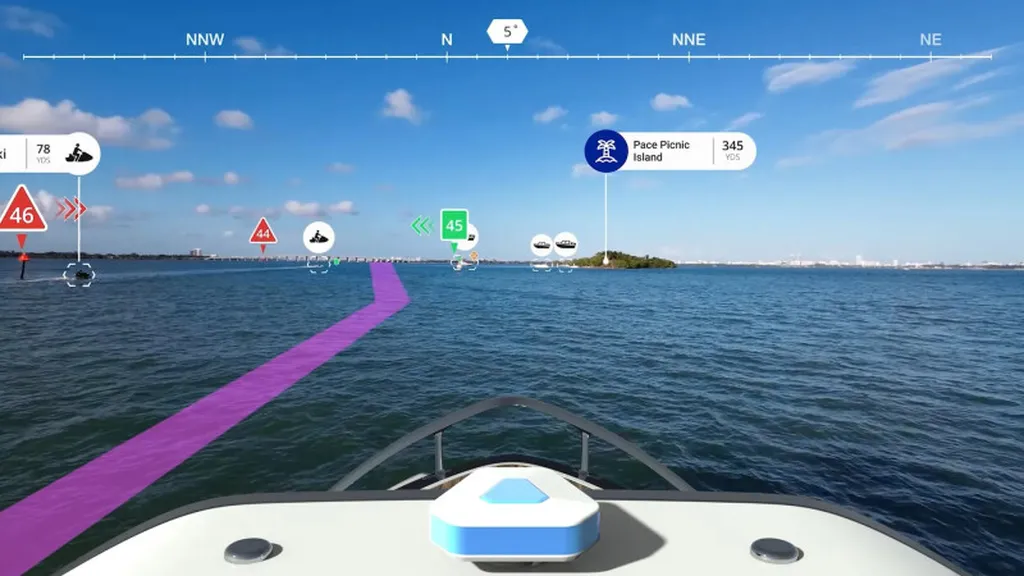
In a significant stride towards enhancing ship navigation systems, researchers have developed a novel framework that leverages the power of large language models (LLMs) to improve decision-making in complex and undefined sailing scenarios. The study, led by Feng Ma from the State Key Laboratory of Maritime Technology and Safety (SKLMTS) at Wuhan University of Technology, introduces the Nav-DLLC architecture, which aims to bridge the gap between traditional navigation systems and advanced LLM technology.
The Nav-DLLC architecture employs a dual-LLM-core-driven approach to decompose intricate navigation tasks into manageable subtasks. This method reduces the likelihood of errors by invoking external tools for information collection and processing unstructured data. The system’s collision avoidance core, fine-tuned with low-rank adaptation (LoRA), ensures that decisions comply with the International Regulations for Preventing Collisions at Sea (COLREGs).
According to the study published in ‘Zhongguo Jianchuan Yanjiu’ (translated to English as ‘Chinese Journal of Ship Research’), simulation experiments demonstrated that Nav-DLLC outperformed both LLM baselines and traditional methods like the Dynamic Window Approach (DWA) and Artificial Potential Field (APF). The system achieved an impressive 86% collision avoidance accuracy and a 90% behavior compliance rate. While the decision core’s latency was higher than traditional methods, it remained within the safe time window for collision avoidance.
Feng Ma explained, “Nav-DLLC provides a safe and efficient intelligent decision-making paradigm for complex navigation environments.” This advancement could significantly impact the maritime sector by enhancing the safety and efficiency of ship navigation. The system’s ability to handle unstructured data and comply with international regulations makes it a promising tool for maritime professionals.
The commercial implications of this research are substantial. Shipping companies could benefit from reduced collision risks, leading to lower insurance costs and improved operational efficiency. Additionally, the integration of LLM technology into navigation systems could open new avenues for innovation in the maritime industry, fostering the development of more intelligent and autonomous vessels.
As the maritime sector continues to evolve, the adoption of advanced technologies like Nav-DLLC could play a pivotal role in shaping the future of ship navigation. By embracing these innovations, maritime professionals can look forward to safer, more efficient, and more intelligent navigation systems.