
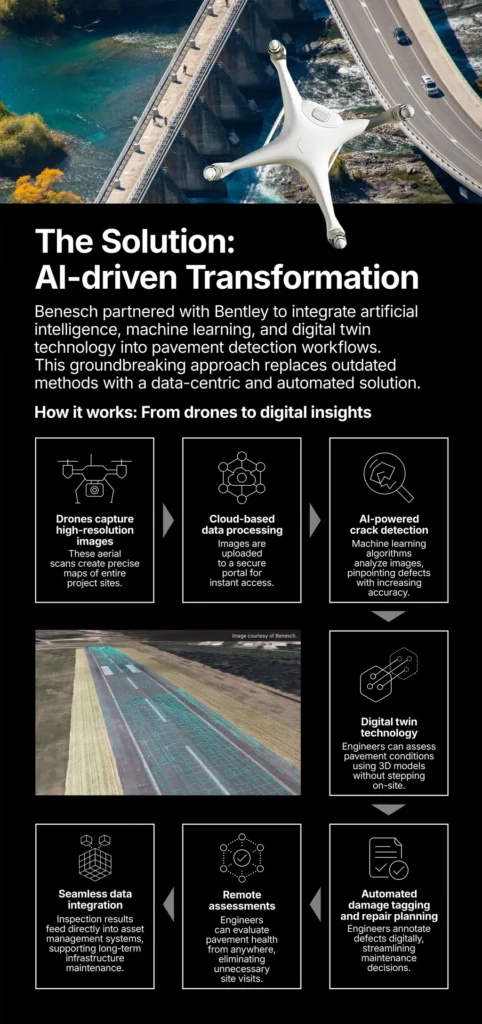
In a significant stride towards automating infrastructure maintenance, researchers have developed a novel system that could revolutionize how we monitor and assess pavement conditions. The study, led by Nada El Desouky from the Civil Engineering Department at The British University in Egypt, introduces an end-to-end vision-based framework for computing the Pavement Condition Index (PCI) using deep learning and robotic deployment. Published in the journal ‘Automation’ (which translates to ‘Automation’ in English), the research presents a fully automated pipeline that integrates real-time image analysis with PCI computation, designed specifically for mobile and robotic platforms.
Traditionally, pavement condition assessment has relied on costly equipment or manual input, often overlooking critical precursors to pothole formation, such as surface weathering. El Desouky’s team addresses this gap by employing deep learning-based object detection and ensemble segmentation to identify and measure multiple types of road distress directly from 2D imagery. “Unlike traditional methods, our system uses advanced computer vision techniques to detect and measure pavement distresses accurately,” El Desouky explained. The system also incorporates a monocular diffusion model for depth estimation, enabling volumetric assessment without the need for specialized sensors.
The implications of this research extend beyond terrestrial applications, offering promising opportunities for the maritime sector. Ports and harbors, which often feature extensive pavement networks, could benefit significantly from autonomous inspection systems. Drones or ground robots equipped with this technology could efficiently monitor pavement conditions, reducing maintenance costs and improving safety. “The potential hardware-agnostic design and modular architecture of our system make it a practical solution for autonomous inspection by drones or ground robots in future smart infrastructure systems,” El Desouky noted.
For maritime professionals, the ability to deploy such systems on autonomous vehicles could streamline maintenance operations, ensuring that critical infrastructure remains in optimal condition with minimal human intervention. This could be particularly valuable in remote or hard-to-reach areas, where traditional inspection methods are less feasible. The research not only highlights the advancements in robotic and computer vision technologies but also underscores the growing importance of smart infrastructure in maintaining and enhancing maritime facilities.