
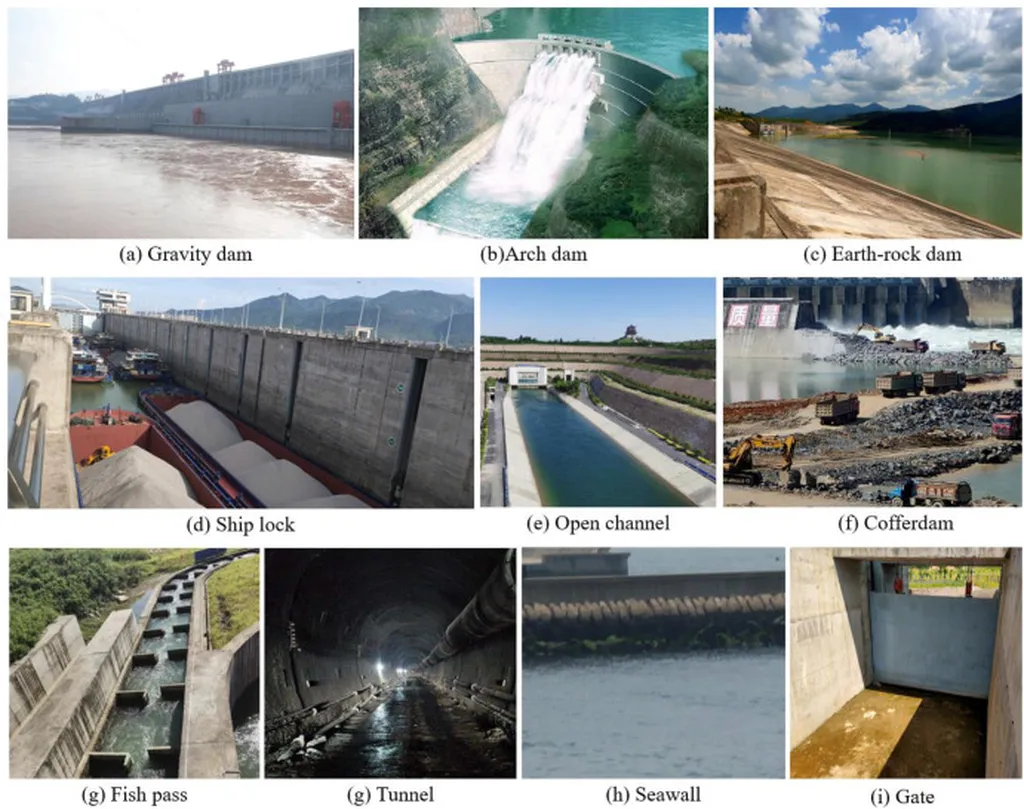
In the world of maritime infrastructure, concrete dams are the unsung heroes, standing tall and steady, holding back the might of water to power our cities and industries. But like any hero, they too face their kryptonite—cracks. These tiny fissures, if left unchecked, can grow into significant problems, compromising the integrity of the dam. Enter Jiarui Hu, a researcher from the College of Transportation Engineering at Dalian Maritime University in China, who’s tackling this issue head-on with a novel approach to crack detection.
Hu and his team have developed a new method for detecting cracks in concrete dams, which they’ve detailed in a recent paper published in the journal ‘Buildings’ (translated from Chinese). The crux of their work lies in a lightweight semantic segmentation framework called MTC-Net. This isn’t your average crack detection tool. It’s a fusion of a MobileNetV2 encoder and Enhanced Transformer modules, designed to achieve what the team calls “global–local feature fusion.” In simpler terms, it’s like giving the system a pair of high-powered binoculars to zoom in on the fine details of the cracks while also keeping an eye on the bigger picture.
But why does this matter for the maritime sector? Well, imagine being able to inspect these massive structures in real-time, with a high degree of accuracy, and without breaking the bank. That’s the promise of this technology. Traditional methods of crack detection can be time-consuming, labor-intensive, and often, not as accurate as we’d like. Hu’s method, on the other hand, significantly reduces the number of model parameters, making it more efficient and faster. This could translate to substantial savings in maintenance costs and downtime for maritime infrastructure.
Moreover, the team has designed a geometry-sensitive Curvature-Aware loss function to mitigate pixel-level class imbalance for fine cracks. In layman’s terms, this means the system is better at spotting those tiny, hard-to-see cracks that could potentially cause big problems down the line. As Hu puts it, “The method greatly improves crack detection accuracy and inference speed, providing a feasible solution for efficient, real-time crack detection in dams.”
The commercial impacts of this technology are substantial. For starters, it could revolutionize the way we approach dam maintenance and inspection. Instead of relying on manual inspections, which can be both dangerous and inefficient, we could deploy this system to continuously monitor the health of our dams. This could lead to earlier detection of potential issues, preventing catastrophic failures and extending the lifespan of these critical structures.
Furthermore, the technology could be adapted for use in other areas of the maritime sector. For instance, it could be used to inspect the hulls of ships, offshore platforms, or even underwater pipelines. Anywhere there’s concrete or steel that’s exposed to the elements and prone to cracking, this technology could potentially be applied.
In the grand scheme of things, Hu’s work is a testament to the power of innovative thinking and cutting-edge technology. It’s a reminder that even the most mundane tasks, like inspecting cracks, can be transformed with the right tools and a bit of creativity. And for the maritime sector, it’s an exciting glimpse into a future where maintenance and inspection are faster, more accurate, and more efficient than ever before. As the old saying goes, “an ounce of prevention is worth a pound of cure.” In the case of dam maintenance, Hu’s technology could be the ounce of prevention we’ve been waiting for.