
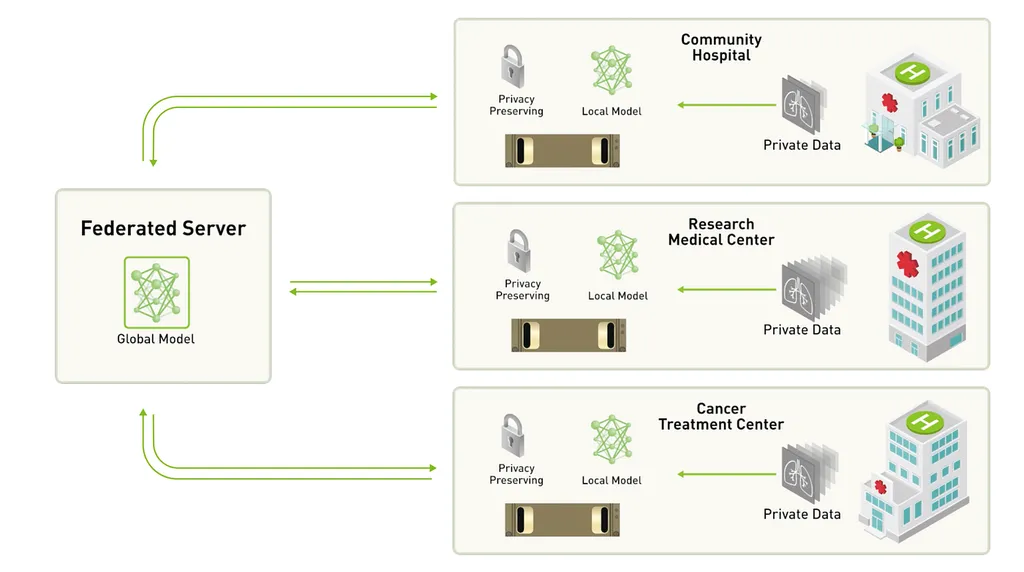
In a groundbreaking study published in the journal ‘Artificial Intelligence’ (AI), researchers have demonstrated how federated learning can revolutionize breast cancer detection using ultrasound imaging. This isn’t just a win for medical tech; it’s a leap forward for privacy-preserving, decentralized data analysis that could ripple into other sectors, including maritime.
Marwa Ali Elshenawy, a computer engineering expert from the Arab Academy for Science, Technology and Maritime Transport in Alexandria, Egypt, led the research. Her team compared different federated learning (FL) frameworks to classify breast cancer types from ultrasound images. They used three datasets: BUSI, BUS-UCLM, and BCMID, which included images from 600, 38, and 323 patients, respectively.
So, what’s the big deal? Federated learning allows multiple entities to collaborate on machine learning models without sharing their raw data. This is crucial for industries like maritime, where data privacy and security are paramount. Imagine ships and ports sharing insights from their operations to improve efficiency and safety, without exposing sensitive information.
Elshenawy and her team tested five state-of-the-art networks and found that MobileNet, ResNet, and InceptionNet worked best for FL. They also compared two aggregation strategies, FedAvg and FedProx, under different levels of data heterogeneity. The results were impressive. In two-client federations, FL models outperformed local and centralized training, achieving up to 8% higher accuracy and nearly 6% higher macro-F1 scores on average.
Elshenawy noted, “The FL models outperformed local and centralized training, bypassing the adverse impacts of data isolation and domain shift.” This means that even when data is scattered and diverse, FL can still deliver accurate results.
In three-client federations, FedProx on MobileNet maintained stable performance, with the best average accuracy of 73.31% and a macro-F1 of 67.3%, despite stronger heterogeneity. “FedProx on MobileNet maintained a stable performance in the three-client federation with best average accuracy of 73.31%, and macro-F1 of 67.3% despite stronger heterogeneity,” Elshenawy explained.
For the maritime industry, this research opens doors to collaborative data analysis without compromising privacy. Ports could share data on vessel traffic, weather patterns, and operational efficiencies to optimize logistics and reduce emissions. Shipping companies could collaborate on predictive maintenance models to minimize downtime and improve safety.
Elshenawy’s work underscores the potential of federated learning as a scalable, privacy-preserving infrastructure for collaborative medical imaging and breast cancer diagnosis. But the implications extend far beyond healthcare. As Elshenawy puts it, “These results suggest that the proposed multiclass model has the potential to support clinical workflows by assisting in automated risk stratification.” In the maritime world, this could translate to automated risk assessment for vessels, ports, and supply chains.
The study, published in ‘Artificial Intelligence’, is a beacon for industries grappling with data privacy and security challenges. It’s a reminder that innovation doesn’t always mean reinventing the wheel. Sometimes, it’s about finding smarter ways to use the data we already have, without compromising on privacy or security.