
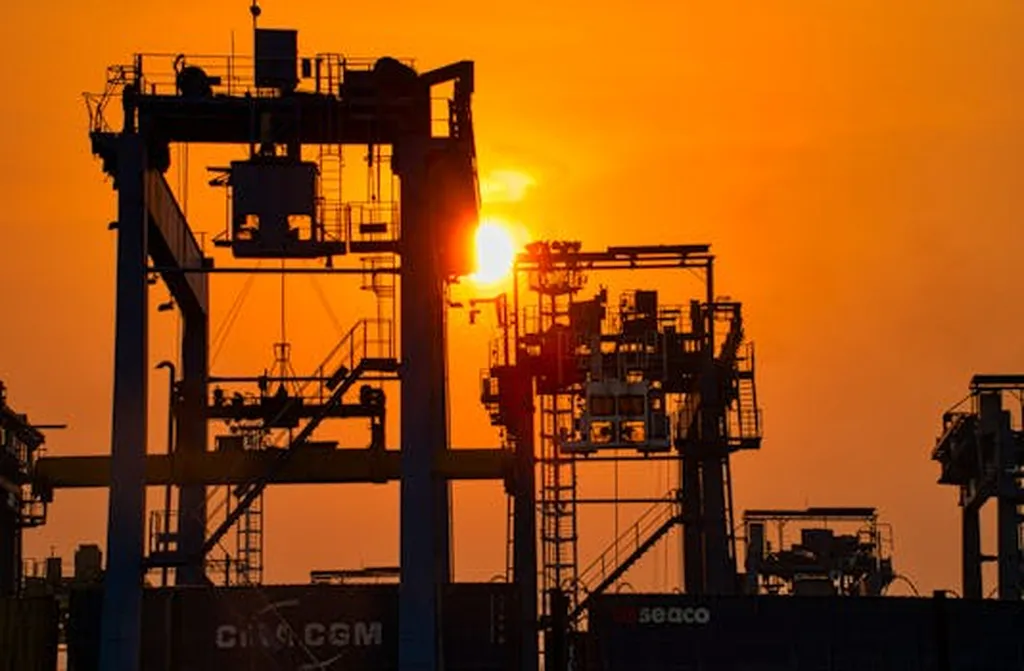
In the bustling world of container terminals, where the dance of trucks and cranes is a carefully choreographed ballet, a new study is making waves. Weili Wang, a researcher from the Institute of Logistics Science and Engineering at Shanghai Maritime University, has developed a framework that could revolutionize the way terminals handle the mix of autonomous and human-driven trucks. Published in the Journal of Marine Science and Engineering, the study, titled “A Simulation-Based Optimization Framework for Collaborative Scheduling of Autonomous and Human-Driven Trucks in Mixed-Traffic Container Terminal Environments,” offers a fresh perspective on improving efficiency and safety in these complex environments.
So, what’s the big deal? Well, imagine a container terminal as a bustling city. There are internal trucks, the residents, and external trucks, the visitors. Both need to get around efficiently, but they often end up in a traffic jam, causing delays and reducing overall productivity. Wang’s research tackles this issue head-on by creating a dynamic scheduling model that considers various constraints and optimizes the flow of both types of trucks.
The model uses a spatio-temporal graph to represent the terminal, with nodes representing locations and arcs representing paths. It takes into account the capacity of these nodes and arcs, as well as path constraints, to create a multi-objective optimization model. The goal? To minimize the maximum completion time of internal trucks and the average waiting time of external trucks.
To achieve this, Wang employed an improved NSGA-II algorithm to generate task assignment solutions. These solutions were then evaluated using discrete-event simulation, which incorporated a dynamic programming-based yard block selection strategy for external trucks and a congestion-aware path planning algorithm.
The results are promising. Under low external truck flow, prioritizing autonomous internal trucks reduced task completion time by 18% to 25%. Under high flow, prioritizing external trucks significantly decreased their average waiting time. The study also identified the optimal configuration ratio between internal and external trucks as approximately 1:2.
So, what does this mean for the maritime sector? For starters, it offers a practical solution to a common problem in container terminals. By optimizing the scheduling of trucks, terminals can improve their operational efficiency, reduce delays, and ultimately increase their throughput. This is particularly relevant as terminals worldwide grapple with the challenges of automation and the integration of autonomous vehicles into their operations.
Moreover, the study provides a theoretical basis for decision-making in terminal management. It offers a tool that can be used to evaluate different scenarios and make informed decisions about truck scheduling and terminal layout.
As Weili Wang puts it, “This research provides a theoretical basis and decision support for enhancing terminal operational efficiency and automation transformation.” And indeed, it does. By offering a practical, simulation-based approach to truck scheduling, Wang’s research is paving the way for smarter, more efficient container terminals.
In the ever-evolving world of maritime logistics, this study is a beacon of innovation. It’s a testament to the power of simulation-based optimization and a promising step towards the future of automated container terminals. As the maritime sector continues to embrace automation, studies like this one will be instrumental in shaping the future of container terminal operations.