
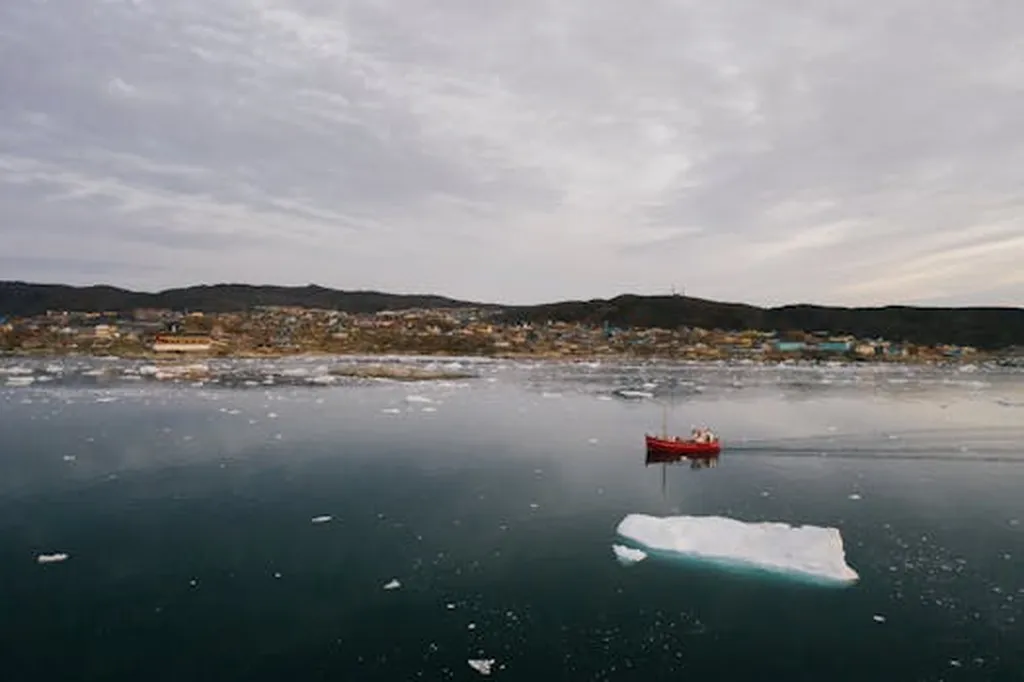
In the harsh and unforgiving Arctic environment, keeping ships and autonomous underwater vehicles (AUVs) on track is a monumental challenge. The region’s poor satellite geometry, ionospheric disturbances, and strong multipath effects can wreak havoc on navigation systems, leading to inaccuracies that can put vessels and their crews at risk. But a recent study published in the Journal of Marine Science and Engineering, led by Wei Liu from the Merchant Marine College at Shanghai Maritime University, offers a promising solution to this pressing problem.
Liu and his team have developed an improved Adaptive Robust Extended Kalman Filter (IAREKF) algorithm designed to significantly enhance the positioning accuracy of shipborne Global Navigation Satellite System (GNSS) and Inertial Navigation System (INS) solutions. In plain terms, this means their new filter can better handle the noisy, unreliable data that’s common in Arctic waters, providing more accurate and reliable navigation information.
The team’s approach involves a tightly coupled GNSS/INS navigation system, which combines data from both systems to improve accuracy. But they didn’t stop there. They also introduced a sliding window mechanism that dynamically adjusts the observation noise covariance matrix using historical residual information. This might sound like a mouthful, but it’s essentially a way to make the system more stable and robust in harsh environments.
The results speak for themselves. In field experiments conducted on an Arctic survey vessel, the proposed method reduced the horizontal root mean square error by 61.78% at 80.3° latitude and 21.7% at 85.7° latitude compared to the Loosely coupled EKF. As Liu puts it, “The proposed improved adaptive robust extended Kalman filter significantly enhances the robustness and accuracy of Arctic integrated navigation.”
So, what does this mean for the maritime industry? For starters, it could make Arctic voyages safer and more efficient. With more accurate navigation data, ships can avoid hazards, optimize routes, and reduce fuel consumption. This is particularly important as shipping routes in the Arctic become increasingly viable due to melting ice caps.
Moreover, the improved navigation accuracy could open up new opportunities for AUVs in the Arctic. These unmanned vehicles are already used for tasks like underwater surveys and environmental monitoring, but their effectiveness is limited by navigation inaccuracies. With better navigation systems, AUVs could play a bigger role in Arctic exploration and research.
The commercial implications are also significant. As Liu notes, “The sparse ground-based augmentation infrastructure and the lack of reliable reference trajectories and dedicated test ranges in polar waters hinder the validation and performance assessment of existing marine navigation systems.” This means there’s a real market need for improved navigation solutions in the Arctic, and companies that can provide them stand to gain.
In conclusion, Liu’s research represents a significant step forward in Arctic navigation technology. By improving the accuracy and robustness of GNSS/INS systems, his work could make Arctic voyages safer, more efficient, and more environmentally friendly. And with the Arctic’s strategic and economic importance only set to increase, the need for such technologies will only grow. As published in the Journal of Marine Science and Engineering, this is one development that maritime professionals should keep a close eye on.