
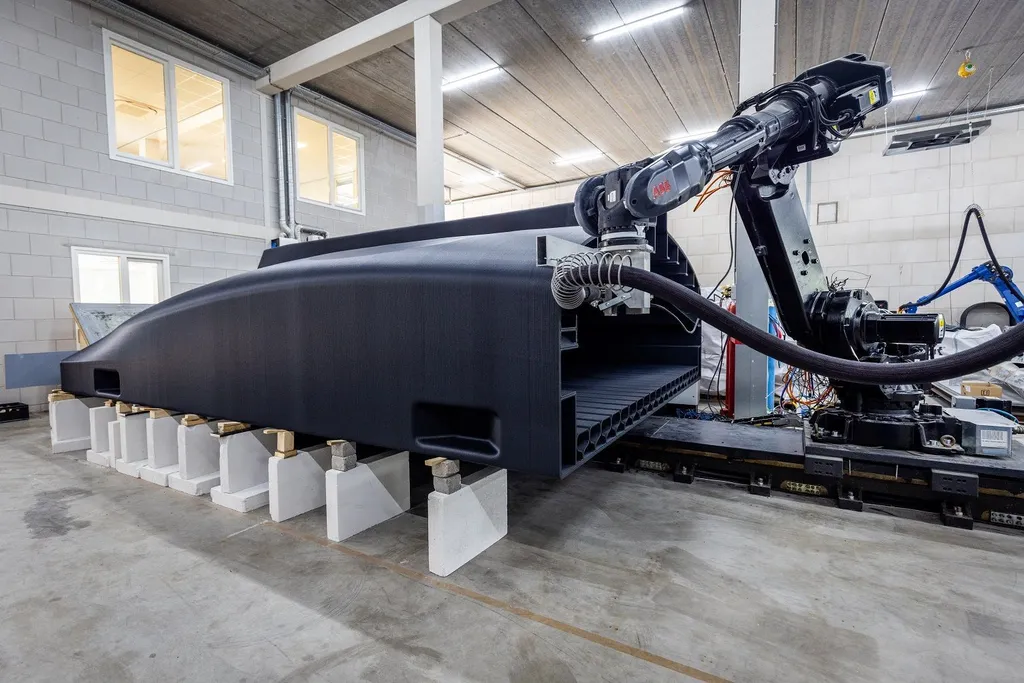
In a move that could potentially revolutionize the maritime industry, a recent study published in the journal ‘Wave’ (translated from Indonesian as ‘Ocean Wave’) has explored the application of 3D printing in the construction of fiberglass-reinforced plastic (FRP) ships. The research, led by Mustika Ningrum from the Department of Naval Architecture at Institut Teknologi Sepuluh Nopember in Surabaya, Indonesia, delves into the benefits, methods, and opportunities presented by this innovative manufacturing technique.
Traditionally, the maritime industry has relied on conventional technologies for shipbuilding, with a strong emphasis on ensuring repeatability and high quality to meet stringent classification requirements. However, the process has often been lengthy, primarily due to the challenges associated with raw materials. Enter 3D printing, a method that offers design optimization, weight reduction, and ease of prototyping, factors that could significantly speed up the shipbuilding process.
Fiberglass, an alternative basic material for shipbuilding, is noted for its sufficient material availability, relatively cheap prices, light weight, and flexibility. Fiberglass boats are known to have a longer service life, corrosion resistance, low production and maintenance costs, and effectively increase fishing yields. However, the conventional methods of hand lay-up and vacuum infusion in the construction of fiberglass boats present difficulties in determining the composition of the material and the emergence of air bubbles, which can decrease the strength of the ship.
Ningrum’s research highlights the chopper gun method as an efficient alternative. This method, combined with 3D printing, could potentially overcome the challenges faced in traditional shipbuilding. As Ningrum explains, “The difficulty of the conventional method of hand lay-up and vacuum infusion in the construction of fiberglass boats is due to the difficulty of determining the composition of the material, as well as the emergence of air bubbles which causes a decrease in the strength of the ship. So the chopper gun method is an efficient method.”
The commercial impacts of this research are substantial. The maritime industry stands to benefit from reduced production times, lower costs, and improved vessel performance. The opportunities for innovation and growth in the sector are vast, with 3D printing and the chopper gun method offering a pathway to more efficient and effective shipbuilding practices.
As the maritime industry continues to evolve, the integration of advanced technologies like 3D printing could play a pivotal role in shaping its future. The research published in ‘Wave’ provides a glimpse into the potential of these technologies, offering a beacon of hope for a more efficient and innovative maritime sector.