
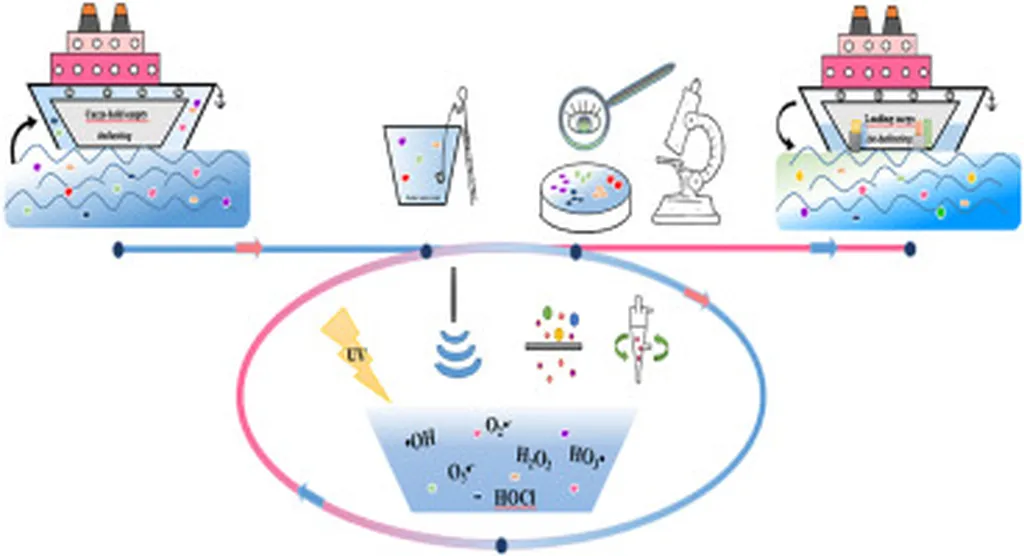
In the vast, interconnected world of maritime trade, there’s a silent menace lurking beneath the waves, one that doesn’t make headlines but has significant ecological and economic impacts. Ballast water, crucial for ship stability, has been inadvertently introducing invasive species, pathogens, and pollutants into marine ecosystems, causing biodiversity loss and economic damage. But there’s hope on the horizon, as a new review published in ‘Biotropia: The Southeast Asian Journal of Tropical Biology’ (translated to English as ‘Tropical Biology: The Southeast Asian Journal of Tropical Biology’) sheds light on sustainable ballast water management strategies.
Lead author Silvia Gabrina Tonyes, a doctoral candidate at the Faculty of Engineering, Udayana University in Bali, Indonesia, and her team have delved into the complex world of ballast water management. They’ve explored the ecological, economic, and public health risks posed by ballast water discharge, and have reviewed existing regulatory frameworks and treatment technologies.
So, what’s the big deal about ballast water? Well, when ships take on ballast water to maintain stability, they often suck up thousands of marine organisms, including invasive species. When this water is discharged at the next port, these species can wreak havoc on local ecosystems, outcompeting native species and disrupting the delicate balance of marine life. This isn’t just an environmental issue; it’s an economic one too. Invasive species can cause significant damage to fisheries, aquaculture, and coastal infrastructure, leading to substantial economic losses.
Tonyes and her team have highlighted the International Maritime Organization’s Ballast Water Management Convention as a key regulatory framework aimed at mitigating these challenges. However, they’ve also identified significant hurdles in implementation and enforcement. This is where technology comes in. The review explores various treatment technologies, including mechanical, chemical, physical, and emerging methods like advanced oxidation processes, electrochlorination, and nanotechnology.
But here’s the kicker: integrated treatment systems, which combine multiple methods, are highlighted as the most effective and eco-safe approach. As Tonyes puts it, “Integrated treatment systems can address the limitations of single-method approaches, offering a more comprehensive solution to ballast water management.”
For maritime professionals, this presents both challenges and opportunities. The challenge lies in the cost, scalability, and compliance of these treatment systems. But the opportunity? Well, as the maritime industry increasingly prioritizes sustainability, companies that invest in and innovate these technologies could gain a competitive edge. Moreover, with the global push towards the Sustainable Development Goals, there’s a growing market for sustainable maritime practices.
The review also emphasizes the importance of international collaboration and capacity building to enhance the effectiveness of ballast water management. This could open up avenues for collaboration between maritime companies, governments, and research institutions.
In the words of Tonyes, “Future directions include the optimization of treatment technologies, harmonization of regulations, and incentivization of compliance to achieve global environmental and economic resilience.” This is a call to action for the maritime industry to step up and play its part in protecting our marine ecosystems and promoting public health worldwide.
So, as we navigate the complex world of maritime trade, let’s not forget the silent menace lurking beneath the waves. Let’s strive for sustainable ballast water management, for the sake of our ecosystems, our economies, and our future. After all, as Tonyes and her team have shown us, there’s hope on the horizon.