
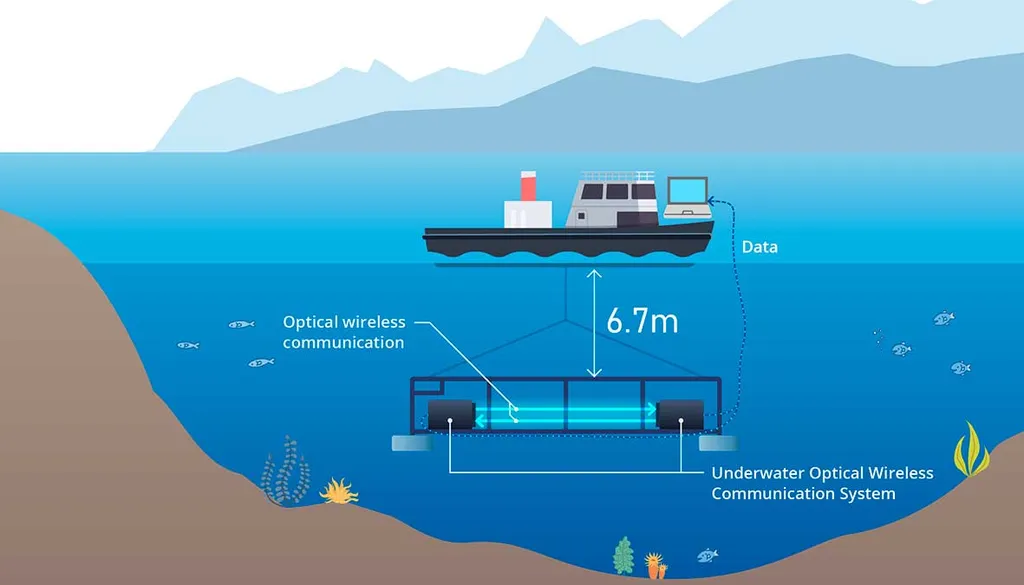
In the murky depths of the ocean, where traditional wireless communication systems struggle, a team of researchers led by Fanghua Li from Fudan University in Shanghai, China, has made a significant breakthrough. Their work, published in the IEEE Photonics Journal, focuses on improving underwater optical wireless communication (UOWC) systems, which use light to transmit data through water. This might sound like a niche area, but the implications for the maritime industry are substantial.
Imagine a scenario where underwater vehicles, sensors, and divers can communicate seamlessly and reliably. This is the promise of UOWC systems, but they face significant challenges, including multi-user interference (MUI) and the dead-time effect in photomultiplier tubes (PMTs), which are used to detect light signals. These issues can degrade performance and limit the practical applications of UOWC.
Li and his team have developed an innovative solution to these problems. They propose an iterative detection method that can handle signal-dependent shot noise, finite sampling rates, and thermal noise. This method uses a sparse interleaver and a dedicated factor graph to improve noise resilience and mitigate MUI. Moreover, they employ iterative multi-user detection (MUD) based on a robust maximum a posteriori probability framework to address the PMT dead-time effects.
The results are impressive. According to Li, “The proposed method achieves up to 5 dB bit error rate (BER) gains over conventional photon-counting schemes and maintains robust performance under diverse channel and noise conditions.” This means that the system can transmit data more accurately and reliably, even in challenging underwater environments.
So, what does this mean for the maritime industry? The potential applications are vast. For instance, underwater vehicles and sensors could communicate more effectively, enabling better coordination and data sharing. This could improve underwater exploration, environmental monitoring, and even military operations. Additionally, the technology could enhance underwater communication for offshore oil and gas operations, as well as underwater mining and construction projects.
Moreover, the system’s robustness to noise and interference means it could be used in a variety of underwater environments, from calm coastal waters to the turbulent depths of the open ocean. This versatility makes it a valuable tool for any maritime operation that requires reliable underwater communication.
In summary, the work of Fanghua Li and his team represents a significant step forward in underwater optical wireless communication. Their innovative approach to addressing the challenges of UOWC systems opens up new opportunities for the maritime industry, enabling more effective and reliable underwater communication. As the technology continues to develop, we can expect to see even more applications and benefits emerge, making our underwater world a little bit more connected.