
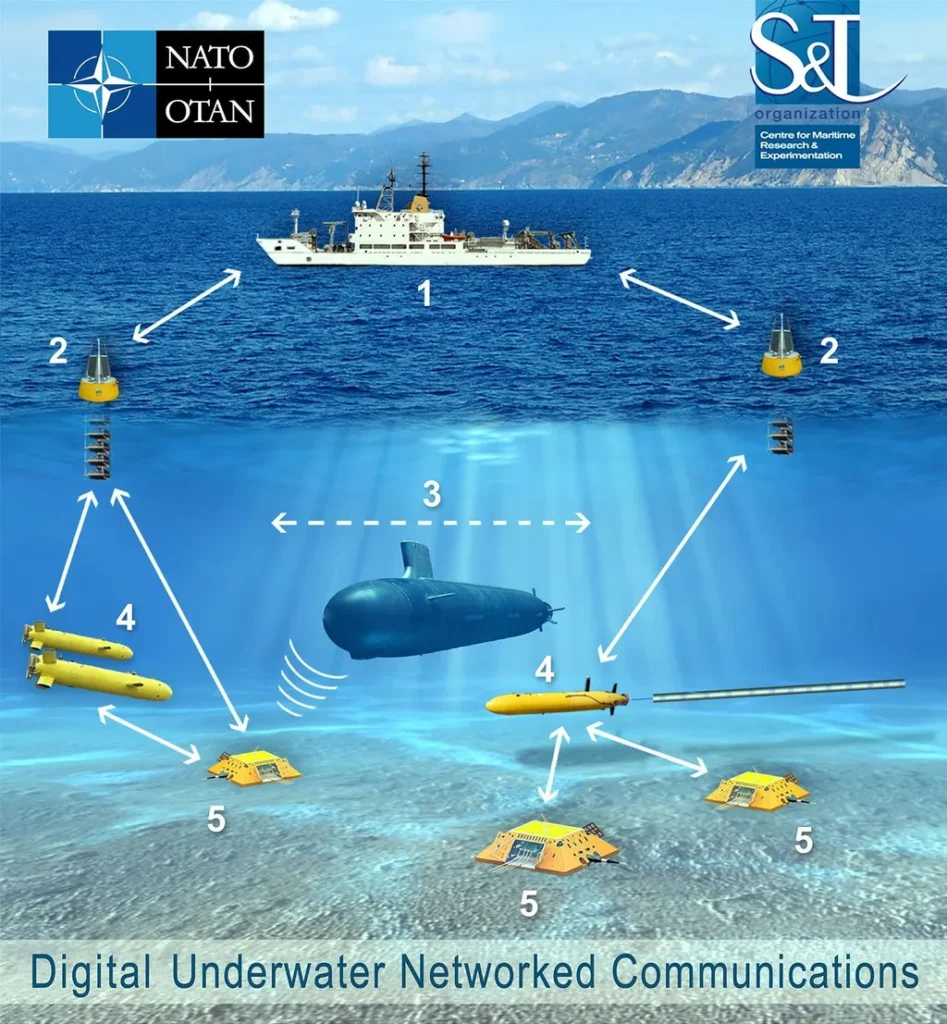
In the ever-evolving world of underwater imaging, a team of researchers led by Frederik Kühne from the Christian-Albrechts-University of Kiel in Germany has made significant strides with their work on multistatic sonar networks (MSNs). Published in the IET Radar, Sonar & Navigation journal, their research delves into the potential of these networks to revolutionize underwater imaging, offering a more detailed and accurate picture of submerged environments.
So, what’s the big deal with MSNs? Well, imagine you’re trying to get a clear picture of an underwater area using a single sonar system. It’s like trying to take a photo with one eye closed. You get a decent image, but it’s not the full picture. Now, enter MSNs. These systems use multiple sonar nodes, each sending and receiving signals, providing a more comprehensive view. As Kühne explains, “The increased degree of freedom in MSNs allows for improved imaging quality, but it also requires additional signal processing.”
The team’s research focuses on the extra processing needed to make MSNs work effectively. They’ve developed techniques for equalizing signals in both coherent and incoherent setups, as well as methods for merging data before detection and tracking algorithms kick in. This is no small feat, as Kühne points out, “The additional signal processing required for such a network of distributed SONAR nodes compared to monostatic SONAR systems is presented.”
But why should maritime professionals care? The potential commercial impacts are substantial. Improved underwater imaging can enhance a wide range of activities, from offshore oil and gas exploration to underwater archaeology and marine conservation. For instance, in offshore wind farm development, accurate underwater imaging is crucial for site assessment, cable laying, and maintenance. Similarly, in the fishing industry, precise underwater mapping can help identify and monitor fish populations, promoting sustainable practices.
Moreover, MSNs can enhance safety in maritime operations. By providing a more detailed underwater picture, these systems can help detect and avoid underwater hazards, such as rocks, wrecks, or other obstacles. They can also aid in search and rescue operations, locating objects or individuals in the water more accurately.
The research also highlights the advantages and drawbacks of MSNs compared to conventional sonar systems. While MSNs offer improved imaging quality, they also require more complex processing and coordination among the distributed nodes. However, as Kühne and his team have shown, these challenges can be overcome with the right techniques and algorithms.
In a real-world test, the team equipped a real-time modular sonar imaging system with their algorithms and conducted measurements in a harbor environment. The results demonstrated the capabilities of MSNs, paving the way for their practical application in various maritime sectors.
In conclusion, the work of Kühne and his team represents a significant step forward in underwater imaging technology. As the maritime industry continues to evolve, the need for accurate and detailed underwater mapping will only grow. MSNs, with their enhanced imaging capabilities, are poised to play a crucial role in meeting this need.