
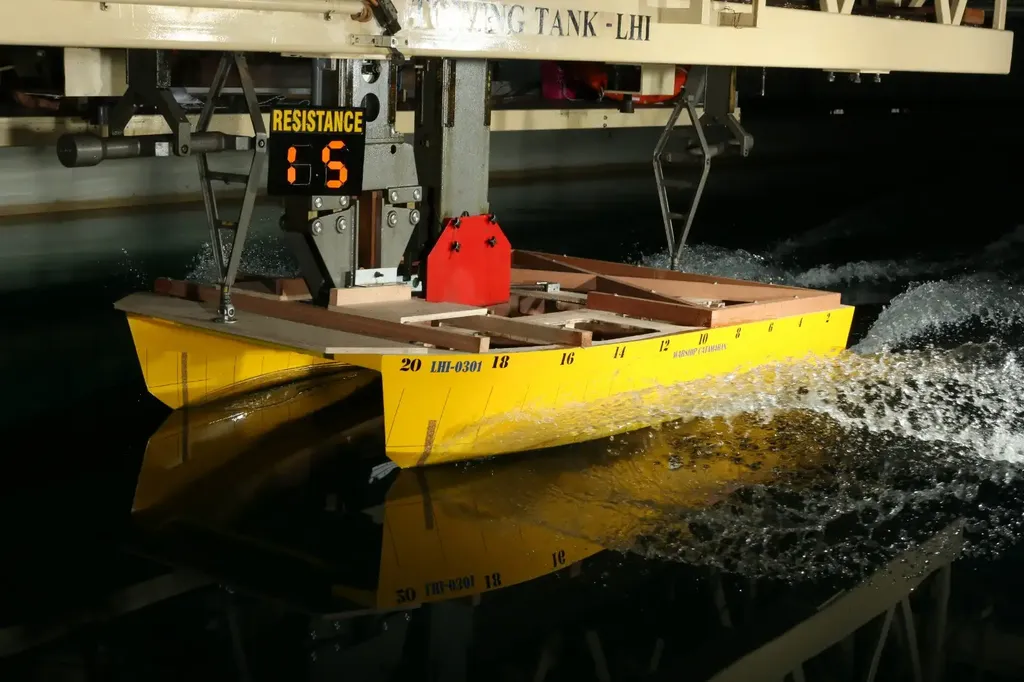
In the bustling maritime hub of Indonesia, a country where the sea is a lifeline, researchers are diving deep into the world of fishing vessel design. Rizqi Fitri Naryanto, a mechanical engineering expert from Universitas Negeri Semarang, has been crunching numbers and running simulations to understand how catamaran-hull fishing vessels perform in Indonesian waters. His work, published in the journal ‘Wave’ (translated from Indonesian), is shedding light on the resistance and wave patterns of these vessels, offering insights that could reshape the fishing industry.
So, what’s the big deal about catamaran-hull fishing vessels? Well, imagine two hulls instead of one, slicing through the water. This design can offer better stability and efficiency, but it’s not a one-size-fits-all solution. Naryanto’s research is all about finding the sweet spot in design to optimize performance. He’s using computational methods, like the Slender Body approach and Savitsky’s mathematical model, to predict how these vessels will behave. It’s like testing a fleet of ships without ever leaving the lab.
Naryanto explains, “The performance of ship design can be quickly predicted using a computational approach.” This is a game-changer for the maritime industry. By understanding the resistance and wave patterns, shipbuilders can design vessels that are more fuel-efficient, reducing operational costs for fishermen. Moreover, better stability means safer journeys, which is crucial for the livelihoods of those who depend on these vessels.
The research focuses on three variations of the catamaran-hull design, each with its own unique characteristics. By comparing these designs, Naryanto aims to identify the most effective configuration for Indonesian waters. This is not just about improving existing vessels; it’s about paving the way for future innovations.
For the maritime sector, the opportunities are vast. Fishing vessels are just the beginning. The principles applied here could be extended to other types of ships, from cargo vessels to passenger ferries. By optimizing hull design, the industry can reduce fuel consumption, lower emissions, and improve overall efficiency. It’s a win-win for both the environment and the economy.
Naryanto’s work is a testament to the power of computational analysis in maritime design. As he puts it, “This analysis is done to take the catamaran-hull fishing vessel design into reference.” By leveraging technology, we can unlock new potentials and drive the maritime industry forward. So, the next time you see a fishing vessel slicing through the waves, remember, there’s a lot of science and engineering behind that smooth ride.