
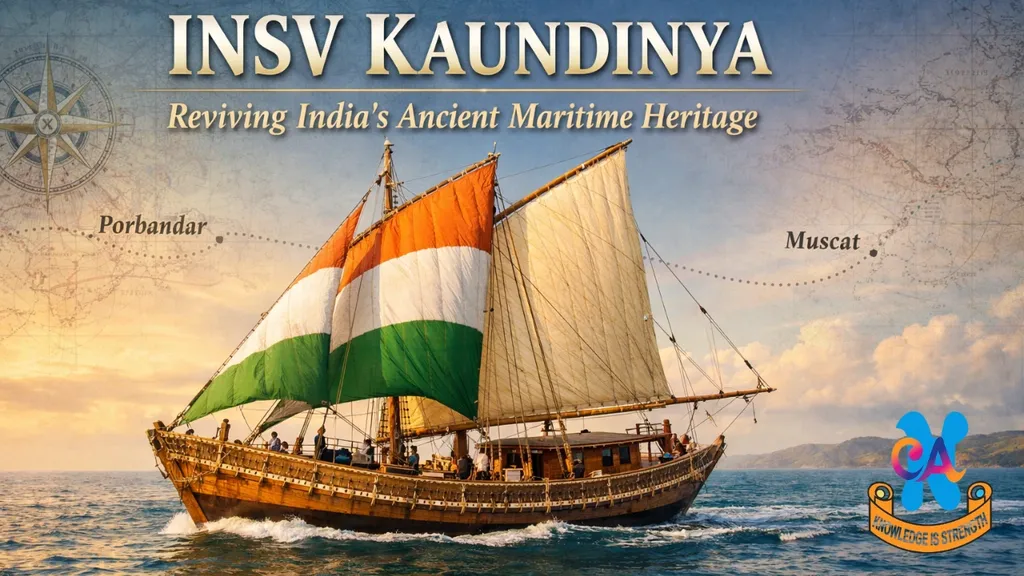
As INSV Kaundinya prepares to set sail on its maiden voyage from Porbandar, Gujarat, to Muscat, Oman, it carries more than just a crew and canvas sails—it embodies a revival of India’s ancient shipbuilding and seafaring traditions. This stitched sailing vessel, a rare blend of history, craftsmanship, and modern naval expertise, is set to retrace the historic maritime routes that connected India with the wider Indian Ocean world for millennia.
The project, a collaboration between the Ministry of Culture, the Indian Navy, and M/s Hodi Innovations, is part of India’s efforts to rediscover and revive indigenous knowledge systems. Built by traditional artisans under the guidance of master shipwright Babu Sankaran, INSV Kaundinya is constructed entirely using traditional stitched-plank techniques. Unlike contemporary vessels, her wooden planks are stitched together using coconut coir rope and sealed with natural resins, reflecting a shipbuilding tradition once prevalent along India’s coasts and across the Indian Ocean.
This technology enabled Indian mariners to undertake long-distance voyages to West Asia, Africa, and Southeast Asia long before the advent of modern navigation and metallurgy. The Indian Navy played a central role in the project, overseeing the design, technical validation, and construction process. With no surviving blueprints of such vessels, the design had to be inferred from iconographic sources. The Navy collaborated with the shipbuilder to recreate the hull form and traditional rigging and ensured that the design was validated through hydrodynamic model testing at the Department of Ocean Engineering, IIT Madras, and internal technical assessment.
The newly inducted vessel incorporates several culturally significant features. Her sails display motifs of the Gandabherunda and the Sun, her bow bears a sculpted Simha Yali, and a symbolic Harappan-style stone anchor adorns her deck, each element evoking the rich maritime traditions of ancient India. Named after the legendary mariner Kaundinya, who is believed to have sailed from India to Southeast Asia in ancient times, the ship embodies India’s historic role as a maritime nation.
Sanjeev Sanyal, historian and member of the Economic Advisory Council to the Prime Minister (EAC-PM), highlighted the broader historical significance of the project. “Beyond the technical experiment, the project carries a broader historical objective. Indian history has often been portrayed as passive, overlooking centuries of maritime activity, trade, and exploration. Indians were not sitting around waiting for conquerors to give them civilisation. We had adventurers, mercenaries, traders, and sailors. Long before the Phoenicians, Indians were sailing across the Indian Ocean,” he said.
As INSV Kaundinya sets sail, it carries with it a renewed effort to reclaim a forgotten chapter of India’s oceanic past. The voyage is not just a technical achievement but a testament to India’s timeless maritime connect with the Indian Ocean world. It serves as a reminder of the country’s rich maritime heritage and its enduring legacy of exploration, trade, and cultural exchange.