
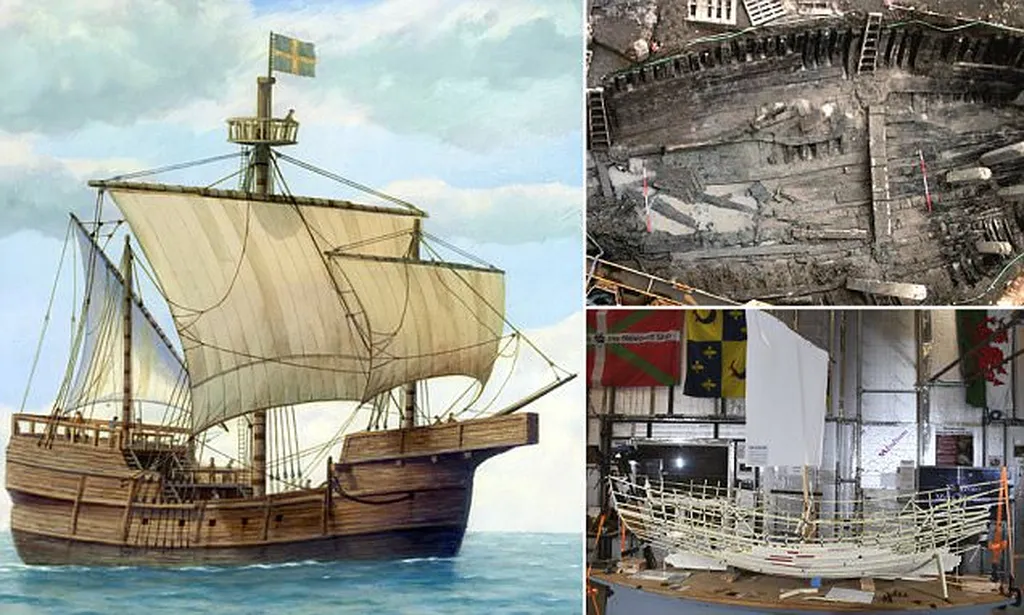
In the bustling waters of the Sound, the strait between Denmark and Sweden, maritime archaeologists stumbled upon something extraordinary. While investigating the seabed for Copenhagen’s new district, Lynetteholm, they uncovered the largest cog ship ever discovered—a vessel that promises to rewrite our understanding of medieval trade and shipbuilding.
From the moment they began their work, the archaeologists knew they had found something special. “The find is a milestone for maritime archaeology. It is the largest cog we know of, and it gives us a unique opportunity to understand both the construction and life on board the biggest trading ships of the Middle Ages,” says Otto Uldum, maritime archaeologist and excavation leader.
Named Svælget 2 after the channel where it was found, this medieval super ship measures approximately 28 metres long, 9 metres wide, and 6 metres high, with an estimated cargo capacity of 300 tons. Built around 1410, it stands as the largest example of its type ever discovered. The sheer size of the cog reflects a society in transition, where trade was becoming increasingly structured and sophisticated.
“A ship with such a large cargo capacity is part of a structured system where merchants knew there was a market for the goods they carried. Svælget 2 is a tangible example of how trade developed during the Middle Ages,” stresses Otto Uldum. The cog was an efficient ship type, capable of being sailed by a small crew even when heavily loaded. Large cogs were built to navigate hazardous voyages, transporting goods from the Netherlands through the Sound to the trading towns of the Baltic.
Svælget 2 points directly to the extensive trade networks that bound Northern Europe together in the 15th century. “It is clear evidence that everyday goods were traded. Shipbuilders went as big as possible to transport bulky cargo – salt, timber, bricks, or basic food items,” says Otto Uldum. The cog revolutionised trade in Northern Europe, making it possible to transport goods on a scale never seen before. This transformation allowed everyday commodities to be shipped across great distances, changing the economic landscape of the region.
Dendrochronological analysis reveals that Svælget 2 was built around 1410 using timber from two regions: Pomerania, which is modern-day Poland, and the Netherlands. The planks were made of Pomeranian oak, while the frames—the ship’s ribs—came from the Netherlands. This construction pattern suggests a complex trade network where large quantities of timber moved across Northern Europe.
“It tells us that timber exports went from Pomerania to the Netherlands, and that the ship was built in the Netherlands where the expertise to construct these very large cogs was found,” says maritime archaeologist Otto Uldum. The heavy planking timber was imported, while the frames were cut locally at the building site, reflecting a practical approach to shipbuilding.
Svælget 2 is not only the largest cog ever found; it is also exceptionally well preserved. The wreck was excavated at a depth of 13 metres, where it has been shielded from the forces that normally destroy ships near the coast. Sand has protected the starboard side from keel to gunwale, something never seen before in a cog find. In this area, archaeologists uncovered remarkable traces of the ship’s rigging.
“It is extraordinary to have so many parts of the rigging. We have never seen this before, and it gives us a real opportunity to say something entirely new about how cogs were equipped for sailing,” explains Otto Uldum. These discoveries give researchers a unique opportunity to study construction details and understand the complexity of medieval sailing ships.
The finds show how something as complex as the rigging was solved on the largest cogs. Rigging is absolutely central to a medieval ship, as it makes it possible to control the sail, secure the mast, and keep the cargo safe. Without ropes and rigging, the ship would be nothing,” says the maritime archaeologist.
A distinctive feature of medieval cogs is the high castles at the bow and stern, timber-built platforms known from countless illustrations. Until now, however, there has been no secure archaeological evidence that these castles actually existed. According to maritime archaeologist Otto Uldum, that has changed with Svælget 2.
“We have plenty of drawings of castles, but they have never been found because usually only the bottom of the ship survives. This time we have the archaeological proof.” The scale of the find makes it even more significant. Researchers have uncovered extensive remains of a real timber-built stern castle, a covered deck where the crew could seek shelter and stay relatively protected. This discovery is a breakthrough because it provides far more material than ever before, allowing researchers to understand how these structures were built and used.
“We now have 20 times as much material to work with. It is not comfort in