
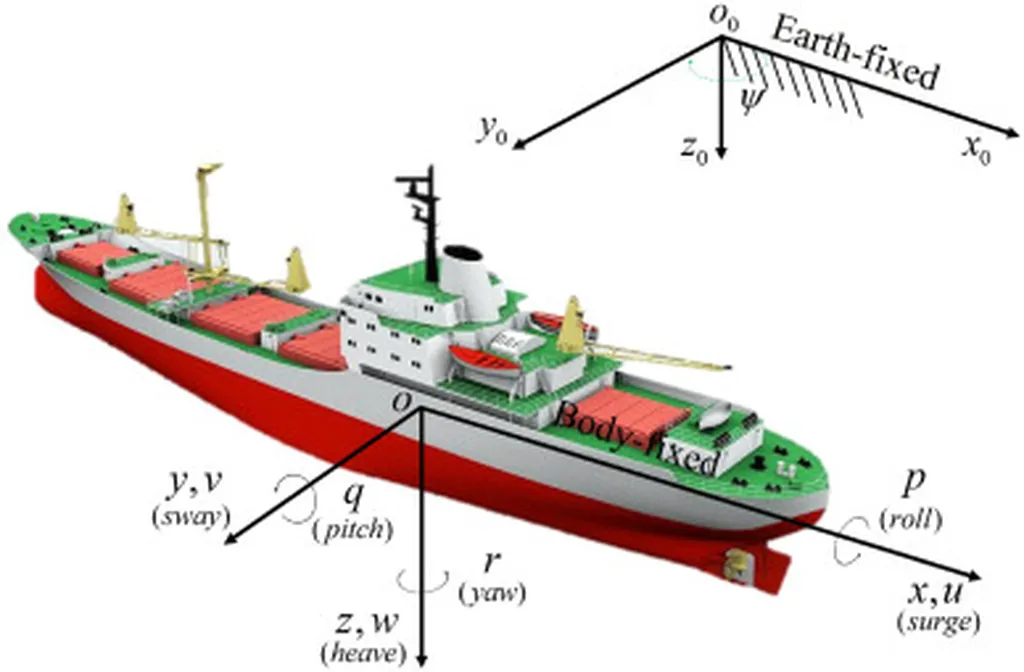
In a significant stride towards enhancing the maneuverability of unconventional ships, a team of researchers from the State Key Laboratory of Maritime Technology and Safety at Wuhan University of Technology has developed a novel approach to modeling ship maneuvering motions. The study, led by ZHENG Mao, DING Shigan, and LAN Jiafen, was recently published in the Shanghai Jiaotong University Journal, also known as ‘Shanghai Jiaotong Daxue xuebao’.
The researchers tackled the challenge of creating a maneuvering model for unconventional ships, which often have unique hull forms that don’t fit traditional modeling methods. They turned to numerical calculations and simulations to build a framework that could accurately predict how these ships move and respond to control inputs.
To make this work, they performed static oblique towing tests and dynamic circular motion tests using numerical simulations. This allowed them to gather data on the forces acting on the ship’s body, which is crucial for determining the hydrodynamic derivatives needed for the maneuvering model. But they didn’t stop there. To improve the accuracy of these nonlinear hydrodynamic derivatives, they developed a hybrid method that combines cubic spline interpolation with least squares fitting.
The results were impressive. When they put their model to the test with zigzag and rotation tests on a scaled ship model, it performed exceptionally well, demonstrating good accuracy. As ZHENG Mao put it, “The maneuvering motion model established by numerical calculation and the hybrid method has good accuracy and can be used for modeling unconventional ship maneuvering motion.”
So, what does this mean for the maritime industry? Well, unconventional ships are becoming more common, from specialized research vessels to unique offshore platforms. Having a reliable way to model and predict their maneuvering capabilities is a big deal. It can help in the design process, ensuring that these ships are safe and efficient. It can also aid in training for ship operators, allowing them to better understand how their vessels will respond in different situations.
Moreover, this research could open up new opportunities for the maritime sector. As DING Shigan explained, “This method can be applied to various types of unconventional ships, providing a powerful tool for ship designers and operators.” This could lead to more innovative ship designs and improved operational procedures, ultimately making maritime transport safer and more efficient.
In the end, this research is a testament to the power of numerical simulations and advanced modeling techniques. It’s a tool that can help the maritime industry navigate the challenges of unconventional ship design and operation. And with the continued efforts of researchers like ZHENG Mao, DING Shigan, and LAN Jiafen, we can expect to see even more advancements in this field in the future.