
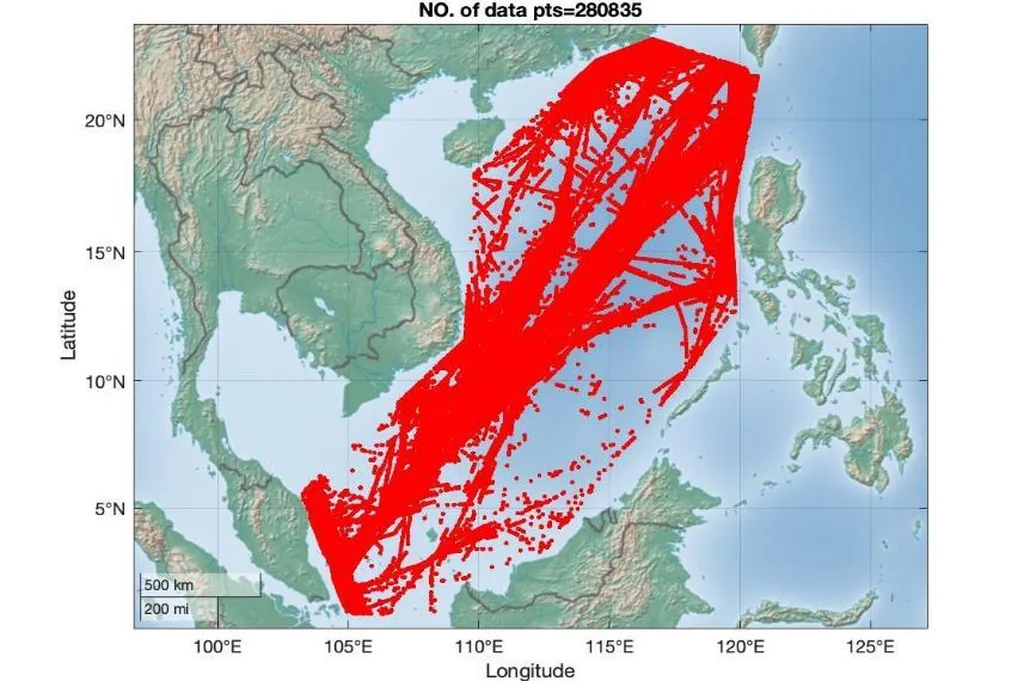
In the bustling waters of Southeast Asia, where maritime traffic is as diverse as it is dense, keeping tabs on vessel movements is a complex task. A recent study published in the Journal of Applied Informatics and Computing, titled “Two-Stage Maritime Anomaly Detection: Unsupervised Outlier Filtering and Optimized Bidirectional LSTM on Southeast Asian AIS Data,” tackles this challenge head-on. Led by Daffa Afaf Firmansyah from Universitas Dian Nuswantoro, the research presents a novel approach to detecting anomalous vessel trajectories using Automatic Identification System (AIS) data.
So, what’s the big deal? Well, imagine trying to spot a needle in a haystack, but the haystack is moving, and the needle could be anything from a smuggling vessel to a ship in distress. That’s the kind of challenge maritime surveillance systems face daily. The study’s two-stage framework aims to make this task more manageable.
First, it uses unsupervised learning algorithms like DBSCAN and Isolation Forest to filter out noise and identify potential outliers. Think of it as a preliminary scan that narrows down the haystack. “The substantial agreement between the methods, with a Cohen’s Kappa of 0.688 and 55.3% anomaly overlap, indicates that they complement each other, enhancing the robustness of the filtering process,” Firmansyah explains.
Once the initial filtering is done, the study employs a Bidirectional Long Short-Term Memory (BiLSTM) model to further analyze the data. This model is optimized through systematic hyperparameter tuning, ensuring it’s well-suited for the task at hand. The results are impressive: the optimized BiLSTM achieves an F1-score of 0.5709, with a precision of 0.5444 and recall of 0.6000. It also exhibits high specificity for normal vessels and sensitivity for anomalies, missing only 23.8% of threats while maintaining a 9.97% false alarm rate.
So, what does this mean for the maritime industry? For starters, it could significantly improve maritime security. By accurately identifying anomalous vessel trajectories, authorities can better detect and respond to potential threats, from smuggling to piracy. Moreover, the study’s approach could be applied to other regions with similar maritime traffic challenges, making it a valuable tool for global maritime surveillance.
The commercial implications are also noteworthy. Maritime companies could use this technology to monitor their fleets more effectively, ensuring the safety and efficiency of their operations. Additionally, the study’s findings could drive the development of new maritime surveillance technologies, creating opportunities for tech companies and startups in the maritime sector.
In essence, this research is a step forward in maritime surveillance technology. As Firmansyah puts it, “The optimized BiLSTM attains balanced performance suitable for human-verified security-critical maritime surveillance in Southeast Asian waters.” And with the technology’s potential for global application, it’s a development worth keeping an eye on. The research was published in the Journal of Applied Informatics and Computing, which translates to “Journal of Applied Informatics and Computing” in English, underscoring its relevance to the tech-savvy maritime professional.