
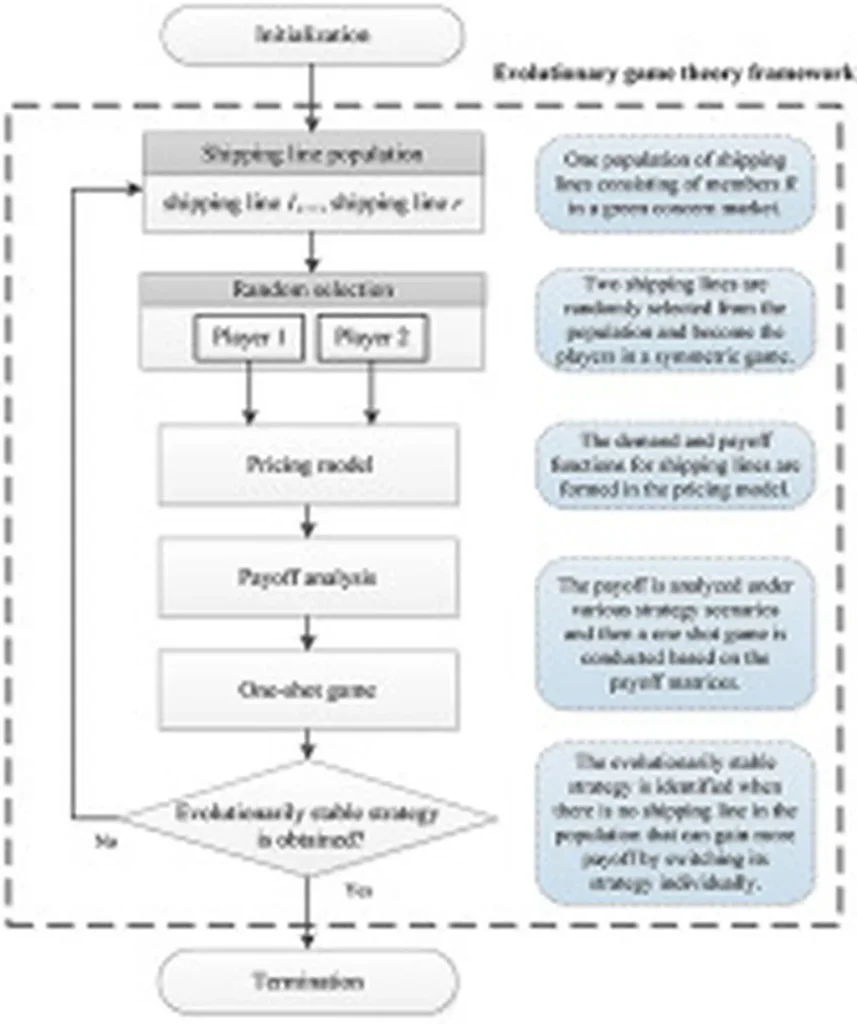
In a bid to tackle the maritime industry’s carbon emissions, a novel study led by Suyong Zhang, affiliated with an undisclosed institution, has shed light on the intricate dynamics between governments, ports, shipping companies, and power providers in promoting shore electricity. Published in the journal ‘Frontiers in Marine Science’ (translated as ‘Frontiers in Marine Science’), the research employs a four-party evolutionary game model to dissect the decision-making processes and interactions among these key stakeholders.
The study, which focuses on the adoption of shore electricity technology, reveals that government policies significantly influence the decision-making processes of all parties involved. “We find multiple stable equilibrium points and their corresponding criteria,” Zhang notes, highlighting the complex interplay of factors at play. The research also underscores that economic considerations are a major hurdle in the widespread adoption of shore electricity, directly impacting the strategic decisions made by each stakeholder.
One of the key findings is that government support can boost the willingness of ports and shipping companies to adopt shore electricity technology. Similarly, power companies are more inclined to invest in this green technology when incentives are in place. “Incentives and cooperation among the stakeholders are shown to be successful strategies for attaining low-carbon growth in the shipping industry,” the study concludes.
For maritime professionals, the research presents both challenges and opportunities. On one hand, the economic barriers to adopting shore electricity technology are real and must be addressed. On the other hand, the study suggests that with the right government policies and incentives, the maritime industry can make significant strides in reducing carbon emissions and promoting sustainable port development.
The commercial impacts of this research are substantial. Shipping companies that proactively adopt shore electricity technology may gain a competitive edge by positioning themselves as environmentally responsible players in the industry. Ports that invest in the necessary infrastructure could attract more shipping traffic, while power companies have the opportunity to diversify their portfolios and tap into a new revenue stream.
Moreover, the study’s sensitivity analysis provides valuable insights into the effects of government incentives and related expenses on each participant. This information can guide policymakers in designing effective strategies to promote shore electricity technology and other low-carbon initiatives in the maritime sector.
In essence, Zhang’s research underscores the importance of collaboration and strategic decision-making in driving the maritime industry towards a more sustainable future. By understanding the dynamics between these four key stakeholders, maritime professionals can better navigate the challenges and seize the opportunities presented by the shift towards low-carbon technologies.