
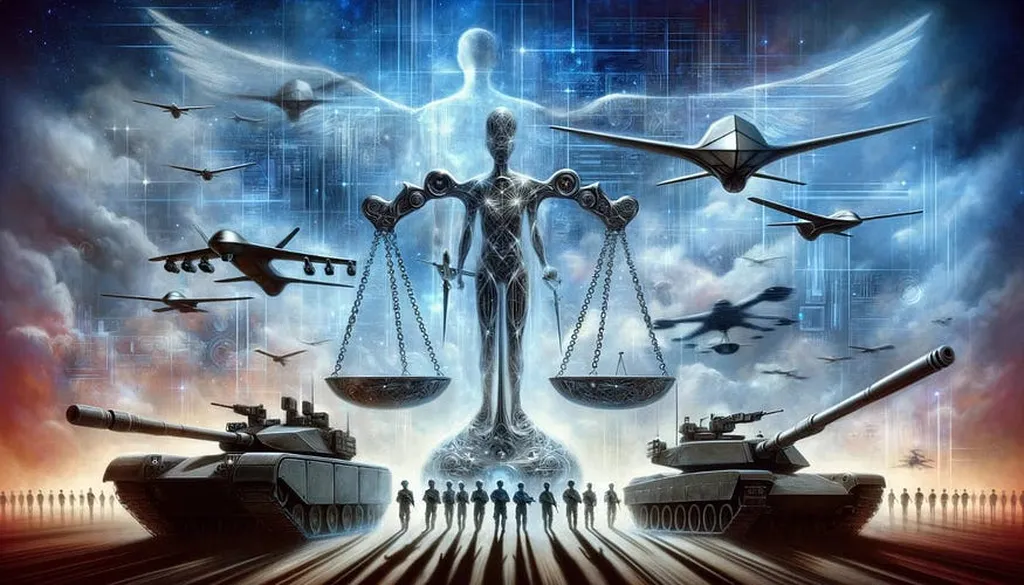
The Evolving Landscape of AI Ethics in Military Applications
AI ethics is a burgeoning area of concern within the artificial intelligence field. High-profile discussions at conferences, the establishment of dedicated safety teams in corporations, and vocal commitments from leaders in government, industry, and academia underscore the urgency of addressing AI’s ethical implications. While concerns often focus on the potential harm to employment and mental health, a critical aspect is frequently overlooked: the military application of AI technology. The prospect of using AI for weaponry raises alarms about the technology’s capability to cause destruction.
While current military AI applications remain in early stages, major nations like the U.S. and China are investing heavily in developing AI-enhanced systems that could redefine military efficacy in areas such as intelligence analysis and autonomous drones. Although existing weaponry largely lacks AI integration, there is a clear trajectory towards machine learning-enhanced military capability, particularly in drones which could navigate autonomously, react in real-time, and operate in data-constrained environments.
A case study illustrating this technological advance is Ukraine’s Operation SpiderWeb, which deployed drones autonomously to strike military assets in Russia, resulting in significant damage. This operation highlighted how drones are shifting from purely human-piloted systems to increasingly autonomous platforms capable of making decisions in critical situations.
In contrast, the Israeli Defense Force exemplifies another dimension of AI use in warfare—surveillance and targeted strikes. The IDF employs automated systems to monitor and identify potential threats among the civilian population in Gaza, emphasizing efficiency in finding targets and carrying out attacks. Technologies like Lavender and “Where’s Daddy?” automate identification and tracking functions, raising ethical questions about their implications on civilian casualties and the scale of surveillance.
Concerns about weaponized AI stretch beyond immediate ethical dilemmas; they highlight issues of regulatory oversight, accountability, and the potential for escalation in conflict. The historical parallels to nuclear proliferation are stark—after the atomic bomb’s invention, it took decades for robust frameworks for regulation to emerge. With AI, there is a risk that its rapid development may outpace the establishment of necessary regulatory measures.
Moreover, the capability-vulnerability paradox presents a dual-edged sword: while AI enhances military strength, it also increases vulnerability to exploitation. Nations relying heavily on AI systems may risk catastrophic failures if those systems are compromised or if critical resources—such as data and computing infrastructure—are lost.
The geopolitical instability exacerbated by AI’s introduction into military strategies heightens tensions among nations, fostering a mistrustful environment that complicates diplomatic relations. Such a climate favors short-term thinking and escalation over conflict resolution, distancing us from potential paths to peace.
AI ethics discussions often sidestep these crucial military applications, focusing instead on issues deemed less controversial, such as algorithmic bias. There’s a profound irony in a movement that seeks to address ethical dilemmas within the technology sector largely ignoring the potential for AI’s use in warfare and the significant implications it carries for human lives. This oversight may stem from the influence of funding sources, as many AI researchers and practitioners operate under the auspices of military contracts, rendering critical conversations about the ethical use of AI in combat a potential threat to their financial stability. Consequently, the dialogue remains dominated by more palatable concerns, neglecting the pressing issue of military AI and its moral implications.
Ultimately, the current iteration of the AI ethics movement lacks critical engagement with these pressing military applications. An authentic ethical approach to AI must address these dimensions, fostering a deeper inquiry into how technology intersects with power dynamics in warfare, and encouraging a shift from escalation towards dialogue and diplomatic resolution. This requires a fundamental reassessment of the values guiding AI development, ensuring that ethical considerations extend beyond mere technological advancement to encompass the broader ramifications of weaponizing AI. In doing so, we can better navigate the complexities of a rapidly evolving technological landscape and its implications for global conflict and human existence.