
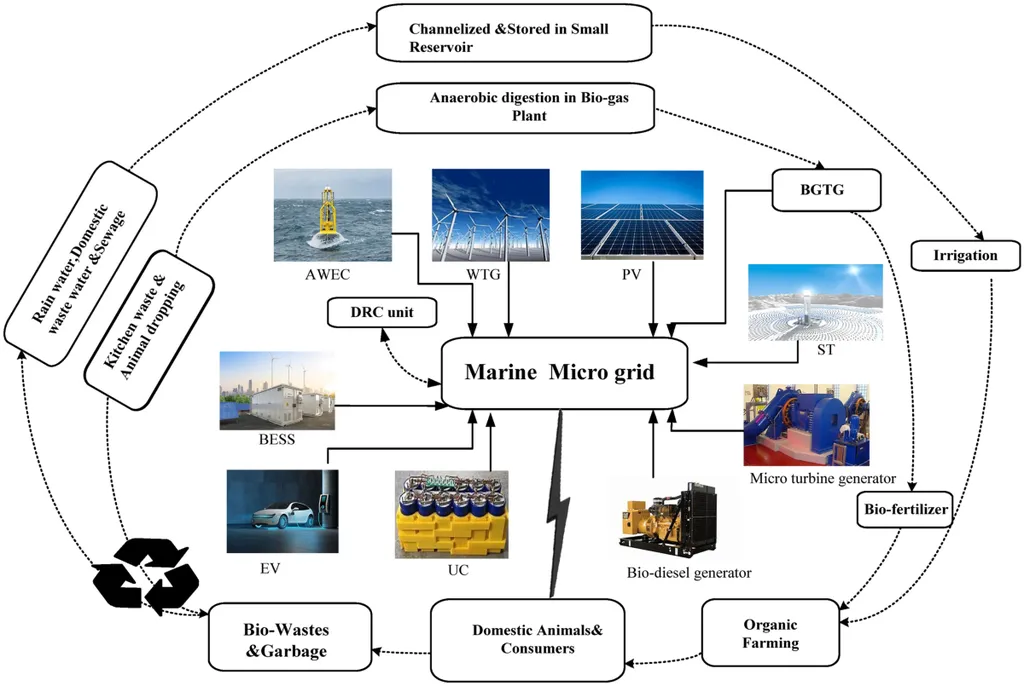
In a significant stride towards enhancing renewable energy integration, a team of researchers led by Marwa Hassan from the Arab Academy for Science, Technology & Maritime Transport has introduced an adaptive Shared Energy Storage (SES) framework tailored to Egypt’s unique energy landscape. Published in the journal Scientific Reports, the study presents a novel approach to managing energy storage that could have substantial implications for maritime sectors and other industries reliant on stable, renewable energy sources.
The research addresses a critical challenge in renewable energy systems: the efficient use of energy storage. Traditional methods often rely on fixed allocations or full cooperation models, which can be inflexible and inefficient. Hassan and her team proposed a dynamic SES partitioning system that adjusts storage access in real-time based on grid demand, market prices, and forecast variations. This adaptive approach integrates Nash bargaining-based cooperation and a distributed Alternating Direction Method of Multipliers (ADMM) optimization algorithm, enabling flexible, real-time leasing of centralized SES units by multiple renewable producers.
One of the standout findings is the framework’s ability to increase storage utilization by over 40% compared to fixed allocation methods, while maintaining economic viability. This is particularly noteworthy given the uncertainties inherent in renewable energy systems, such as forecast errors and battery degradation. “Under ±10% prediction errors or reduced round-trip efficiency, the system continues to provide stable operation and balanced economic outcomes,” Hassan noted. This resilience is crucial for industries like maritime, where reliable energy supply is paramount.
The Nash bargaining mechanism ensures equitable benefit sharing between producers and the SES operator, fostering a cooperative environment that could be beneficial for collaborative energy projects. The distributed ADMM algorithm, meanwhile, enables scalable, near-real-time coordination, making the system adaptable to the dynamic needs of various industries.
For the maritime sector, the implications are substantial. Ships and port facilities increasingly rely on renewable energy sources to reduce emissions and comply with environmental regulations. An adaptive SES framework could enhance the reliability and efficiency of these energy systems, supporting the maritime industry’s transition to cleaner energy sources. Moreover, the framework’s economic resilience could make renewable energy projects more attractive to investors, potentially accelerating the adoption of green technologies in the maritime sector.
Hassan’s research also aligns with Egypt’s Vision 2035 priorities, offering insights for policymakers and grid operators considering SES deployment at scale. The study’s findings could serve as a blueprint for other countries looking to integrate renewable energy sources more effectively into their grids.
In summary, the adaptive SES framework proposed by Hassan and her team represents a significant advancement in renewable energy management. By enhancing storage utilization, ensuring economic viability, and promoting equitable cooperation, this innovative approach could pave the way for more reliable and efficient renewable energy systems, benefiting industries like maritime and supporting global efforts towards sustainable energy transitions.