
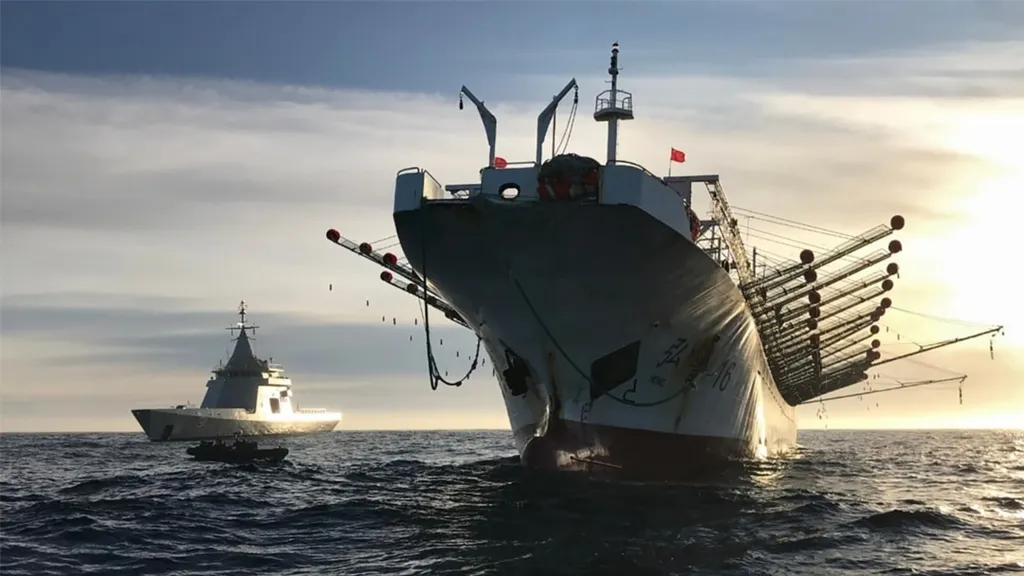
In the bustling maritime hub of Guangdong Province, China, a recent study has cast a spotlight on the critical issue of fishing vessel safety, offering insights that could reshape how the industry approaches risk management. Led by Yingbang Huang from the College of Ocean and Meteorology at Guangdong Ocean University, the research, published in the journal ‘Frontiers in Marine Science’ (which translates to ‘Frontiers in Marine Science’ in English), delves into the safety status of fishing vessels, using a comprehensive, multi-method framework to analyze data from 687 accidents between 2019 and 2023.
The study, which combines the International Maritime Organization (IMO) taxonomy, Kernel Density Estimation (KDE), grid-based accident location statistics, and Exploratory Data Analysis (EDA), reveals some stark findings. “Collision” accidents, for instance, accounted for the highest proportion at 47.16%, making them the primary accident type. On the other hand, while “Mechanical Damage/Failure” incidents were less frequent (7.28%), they resulted in severe casualties in 98% of cases, highlighting their high hazard potential.
The research also uncovers significant differences in vessel length, tonnage, and power output among fishing vessels of different materials, such as steel versus fiberglass. Spatial analysis further identifies the coastal areas from Yangjiang and Maoming to Zhanjiang, along with the Pearl River Estuary, as extremely high-risk zones. Accident distribution also exhibits pronounced spatiotemporal clustering, with a peak in August and the highest risk occurring at 9:00 AM.
For maritime professionals, these findings present both challenges and opportunities. The study proposes targeted measures such as strengthening technical prevention and precise supervision, establishing a dynamic risk-tiered control mechanism, and constructing a data-driven long-term management system. These recommendations could drive the development of new safety technologies, improve vessel design, and enhance maritime safety regulations.
As Yingbang Huang notes, “This study not only deepens systematic understanding of fishing vessel safety risks in Guangdong Province but also provides replicable empirical evidence and decision support for relevant fisheries safety authorities.” The insights gleaned from this research could indeed pave the way for safer, more efficient maritime operations, benefiting not just Guangdong Province but the broader maritime industry.
In an industry where safety is paramount, this study serves as a wake-up call and a roadmap, offering a clearer picture of the risks and pointing the way towards a safer future. As the maritime sector continues to evolve, such research will be instrumental in shaping policies and practices that prioritize safety and sustainability.