
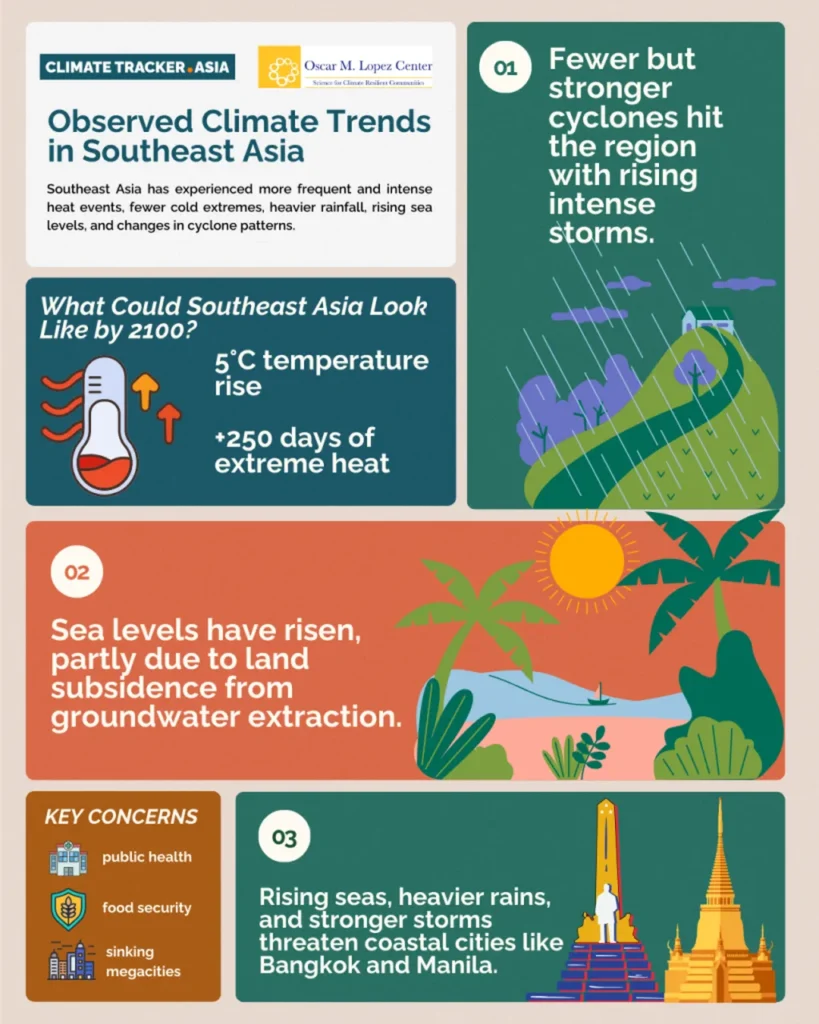
In a twist that’s got meteorologists and maritime professionals alike raising their eyebrows, a recent study has uncovered a shift in the rainfall patterns across Southeast Asia (SEA). The research, led by Junjun Li from the National Institute of Education at Nanyang Technological University in Singapore, and published in the journal Environmental Research Letters (which, funnily enough, is exactly what it sounds like—letters about environmental research), has revealed that while typhoon-related rainfall is on the decline, heavy precipitation from non-typhoon sources is on the rise. And it’s not just a little bit—it’s a significant shift that’s got implications for everyone from coastal communities to shipping routes.
So, what’s the deal? Well, Li and his team crunched the numbers from 1960 to 2024, using a typhoon track dataset and three high-resolution precipitation products. They found that typhoon-precipitation contribution to total rainfall has been decreasing across the entire SEA, both on the mainland and in the maritime regions, especially during the boreal summer half-year. That’s the period from around April to September, for those of you keeping track at home. But here’s the kicker: while typhoon-related rainfall is decreasing, non-typhoon heavy precipitation is increasing in terms of area coverage, even if the intensity of these events is decreasing.
“Our findings indicate a shifting hazard regime,” Li explained. “A decrease in typhoon-related rainfall is being offset by a spatial expansion of non-typhoon heavy precipitation, introducing a new regional risk.” In plain English, that means that while we might not be seeing as many massive downpours from typhoons, we’re seeing more widespread heavy rain from other sources. And that’s got some serious implications for the maritime sector.
For starters, shipping routes might need to be re-evaluated. If certain areas are seeing more heavy precipitation, that could mean more rough seas and potentially dangerous conditions for vessels. On the other hand, this shift could also open up new opportunities for maritime businesses. For example, increased rainfall could lead to higher river flows, which could be harnessed for hydropower or other renewable energy sources. And let’s not forget about the potential for increased tourism in areas that might not have been as attractive in the past due to a lack of rainfall.
But it’s not all smooth sailing. The increased risk of flooding and other precipitation-related disasters could also pose a challenge for maritime infrastructure. Ports and harbors might need to be upgraded to better handle increased rainfall, and shipping companies might need to invest in more robust vessels that can handle rougher seas.
In the end, it’s clear that this shift in rainfall patterns is going to have a significant impact on the maritime sector. But with the right planning and investment, it’s also an opportunity for innovation and growth. As Li put it, “The findings provide critical insights into the change of regional precipitation patterns and have implications for disaster management and adaptation in SEA.” So, maritime professionals, it’s time to start paying attention to the weather—and not just the typhoons.