
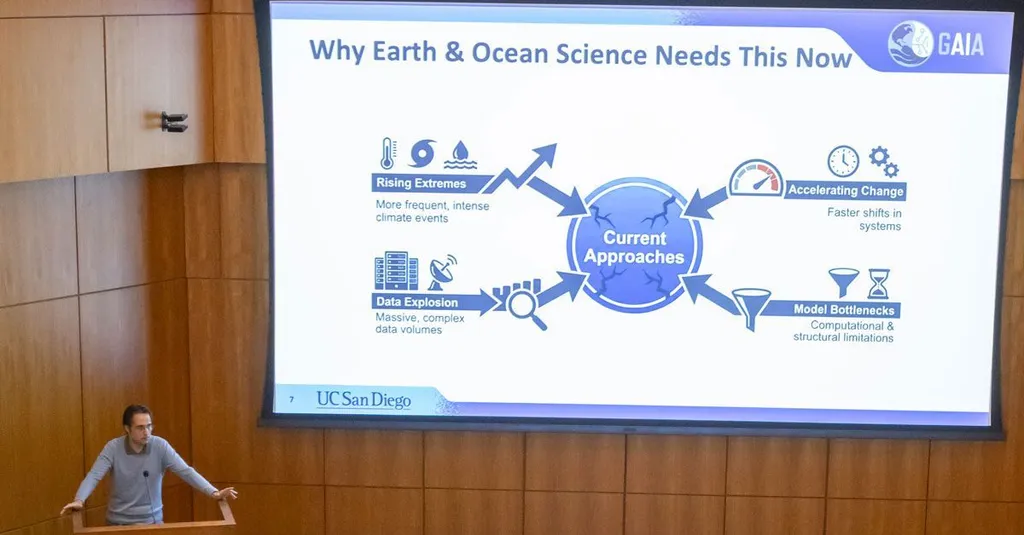
Researchers at the University of California, San Diego, have developed a groundbreaking ocean forecasting model that promises to revolutionize maritime navigation, hazard prediction, and sustainable ocean management. The team, led by Yuan Niu and Qiusheng Huang, has introduced TianHai, a data-driven global ocean forecasting model that delivers predictions at an unprecedented 1/12° eddy-resolving resolution with a vertical extent down to 1,500 meters.
TianHai stands out for its ability to provide sub-daily forecasts every six hours, a significant improvement over existing data-driven models that typically offer daily outputs. This high temporal resolution is crucial for capturing fine-scale dynamical features in the ocean, which are often missed by conventional numerical models. The model’s integration of atmospheric forcings through FuXi-Atmosphere, a data-driven atmospheric forecasting system, further enhances its accuracy by enabling the explicit representation of air-sea coupling effects.
One of the most notable aspects of TianHai is its computational efficiency. Unlike traditional numerical models that require substantial computational resources, TianHai leverages data-driven approaches to deliver high-fidelity forecasts with significantly reduced computational demand. This efficiency makes it a practical tool for real-time applications, such as maritime navigation and hazard prediction, where timely and accurate information is critical.
The researchers conducted benchmark experiments to validate TianHai’s performance. The results demonstrated that TianHai outperforms existing models in forecasting key ocean variables, including temperature and salinity profiles, zonal and meridional currents, sea surface temperature, and sea level anomalies. The model maintained its predictive skill for lead times ranging from 1 to 10 days, indicating its reliability for both short-term and medium-term forecasting.
The practical applications of TianHai are vast. For the maritime industry, the model’s high-resolution forecasts can enhance route planning, improve safety, and optimize fuel consumption by providing accurate information on ocean currents and weather conditions. In hazard prediction, TianHai can help anticipate extreme events such as storms, hurricanes, and tsunamis, allowing for better preparedness and response. For sustainable ocean management, the model can support efforts to monitor and protect marine ecosystems by providing detailed insights into ocean dynamics.
By offering a fully data-driven framework for coupled prediction, TianHai represents a significant advancement in ocean forecasting technology. Its integration of atmospheric and oceanic data, along with its computational efficiency and high resolution, makes it a powerful tool for addressing the complex challenges of maritime navigation, hazard prediction, and sustainable ocean management. As the researchers continue to refine and expand the model, its potential applications are likely to grow, further solidifying its role as a key player in the future of ocean science and technology. Read the original research paper here.