
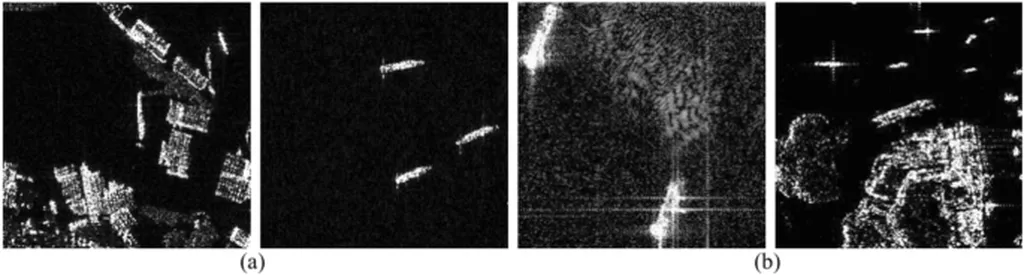
In the vast expanse of the open sea, keeping an eye on maneuvering ships is a critical task for maritime surveillance. However, the images captured by Synthetic Aperture Radar (SAR) often show these ships blurred, making it tough to detect and recognize them. This is where the work of Wenao Ruan from the Aerospace Information Research Institute, Chinese Academy of Sciences, comes into play. Ruan and his team have developed a novel method to sharpen these blurred images, potentially revolutionizing maritime monitoring.
The team’s approach, detailed in a recent study published in the journal ‘Remote Sensing’ (translated from Chinese), is called the Improved Iteration Phase Gradient Resampling Autofocus (IIPGRA) method. In simpler terms, it’s a way to make the blurred images clearer. Here’s how it works: first, they extract the blurred ships from the SAR images. Then, they decompress the images and compensate for any translational motion. The real magic happens next. They propose a centerline-driven adaptive azimuth partitioning strategy. Imagine drawing a line right down the middle of the ship in the image. This line helps them divide the ship into two parts, upper and lower, to maximize the separation of rotational centers between these parts. This division is crucial for accurately estimating the phase errors, which are the main culprits behind the blurriness.
Once the ship is divided, they use a technique called Phase Gradient Autofocus (PGA) to estimate the phase errors of each part and compute their differential. Then, they resample the original echoes based on this differential phase error, which linearizes the non-uniform rotational motion. To ensure the process is robust, they introduce a new metric called the Rotational Uniformity Coefficient (β). This coefficient helps quantify the linearity of the rotational phase, ensuring the iterative process terminates reliably.
So, what does this mean for the maritime industry? Clearer images mean better detection and recognition of ships. This could significantly enhance maritime surveillance, making it easier to track ships, monitor their activities, and ensure maritime safety and security. Moreover, the improved imaging could aid in search and rescue operations, as well as environmental monitoring, by providing clearer images of the sea surface.
In the words of Ruan, “The proposed algorithm can effectively compensate for the rotational motion of maneuvering ships, making them appear sharper in SAR images.” This advancement could open up new opportunities for maritime sectors, from enhancing situational awareness to improving decision-making processes.
The study’s findings were validated using both simulation and real airborne SAR data, proving the effectiveness of the proposed algorithm. As maritime surveillance continues to evolve, the work of Ruan and his team could play a pivotal role in shaping its future.