
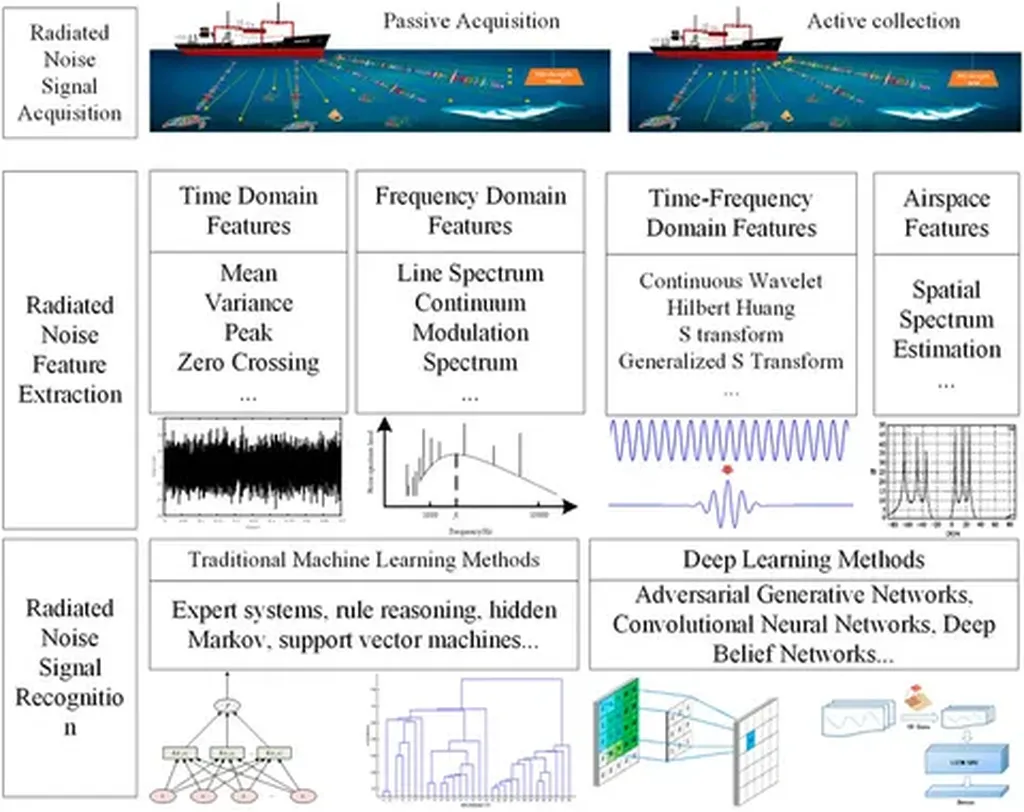
In the ever-evolving world of maritime surveillance, researchers are constantly seeking ways to improve the reliability of underwater acoustic sensing systems. A recent study published in the journal ‘Sensors’ (translated to English from German) tackles this challenge head-on, offering a novel approach to detecting unknown signals in underwater environments. The lead author, Nayeon Kim, from the Department of AI Convergence at the Gwangju Institute of Science and Technology in South Korea, has developed a framework that integrates an out-of-distribution detector for neural networks (ODIN) with Monte Carlo (MC) dropout. This combination aims to mitigate model overconfidence and enhance the separability between known and unknown signals.
So, what does this mean for maritime professionals? In simple terms, the study proposes a method to make underwater acoustic sensing systems more robust and reliable. By using ODIN to calibrate the softmax probability and MC dropout to introduce stochasticity, the system can better estimate predictive uncertainty. This is crucial for stable sensing in real-world underwater environments, where conditions can be unpredictable and varied.
The study’s experimental evaluations on the DeepShip dataset showed promising results. The proposed method achieved an average increase of 9.5% and 5.39% in the area under the receiver operating characteristic curve, and a reduction of 7.82% and 2.63% in the false positive rate at 95% true positive rate, compared to the MC dropout and ODIN baseline, respectively. These improvements highlight the potential of integrating stochastic inference with ODIN for enhancing the stability and reliability of novelty detection in underwater acoustic environments.
For the maritime sector, this research opens up new opportunities for improving maritime security and autonomous navigation. Reliable detection of unknown signals is essential for ensuring the robustness of underwater acoustic sensing systems, as noted by Kim. “Conventional deep learning models often exhibit overconfidence when encountering unknown signals and are unable to quantify predictive uncertainty due to their deterministic inference process,” Kim explained. The proposed framework addresses these limitations, offering a more reliable and stable solution for underwater acoustic sensing.
The commercial impacts of this research are significant. Enhanced novelty detection can lead to improved maritime surveillance, better detection of underwater threats, and more reliable autonomous navigation systems. This can translate to increased safety and efficiency for maritime operations, as well as potential cost savings from reduced false positives and improved system performance.
In summary, the study by Nayeon Kim and her team represents a significant step forward in the field of underwater acoustic sensing. By integrating ODIN with MC dropout, they have developed a framework that enhances the reliability and stability of novelty detection in underwater environments. This research not only advances our understanding of underwater acoustic sensing but also offers practical benefits for the maritime sector, paving the way for more robust and reliable maritime surveillance and navigation systems.