
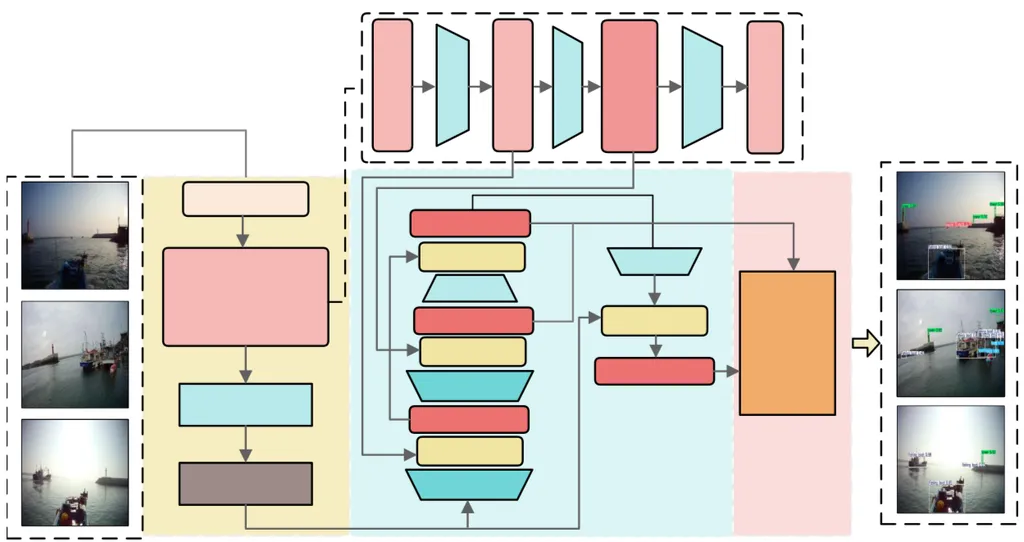
Researchers at the University of Chinese Academy of Sciences have developed a new architecture for maritime object detection that could significantly enhance the safety and efficiency of shipborne navigation. The team, led by Yu Zhang and Fengyuan Liu, introduces Navigation12, a novel dataset annotated for 12 object categories under diverse maritime environments and weather conditions. This dataset is designed to address the critical shortage of maritime-specific data, which has historically hindered the deployment of advanced visual perception techniques in the maritime sector.
The researchers have built upon this dataset to propose HMPNet, a lightweight architecture specifically tailored for shipborne object detection. HMPNet incorporates a hierarchical dynamic modulation backbone to bolster feature aggregation and expression. This backbone is complemented by a matrix cascading poly-scale neck and a polymerization weight sharing detector, which together facilitate efficient multi-scale feature aggregation. The innovative design of HMPNet aims to overcome the limitations imposed by the scarcity of maritime data while enhancing the performance of object detection systems in dynamic and challenging maritime environments.
Empirical evaluations of HMPNet have demonstrated its superiority over current state-of-the-art methods. The architecture achieves a 3.3% improvement in mean Average Precision over YOLOv11n, the prevailing model in the field. Additionally, HMPNet reduces the number of parameters by 23%, making it both more accurate and computationally efficient. These advancements are poised to have significant practical applications in the maritime industry, particularly in enhancing the capabilities of autonomous ships and improving the overall safety of maritime navigation.
The development of HMPNet represents a significant step forward in the realm of intelligent maritime navigation. By addressing the critical need for maritime-specific data and advancing the capabilities of object detection systems, this research paves the way for more sophisticated and reliable visual perception techniques in the maritime context. The potential impact of HMPNet extends beyond theoretical advancements, offering tangible benefits for the safety and efficiency of shipborne operations. As the maritime industry continues to evolve, innovations like HMPNet will play a crucial role in shaping the future of autonomous navigation and maritime technology. Read the original research paper here.