
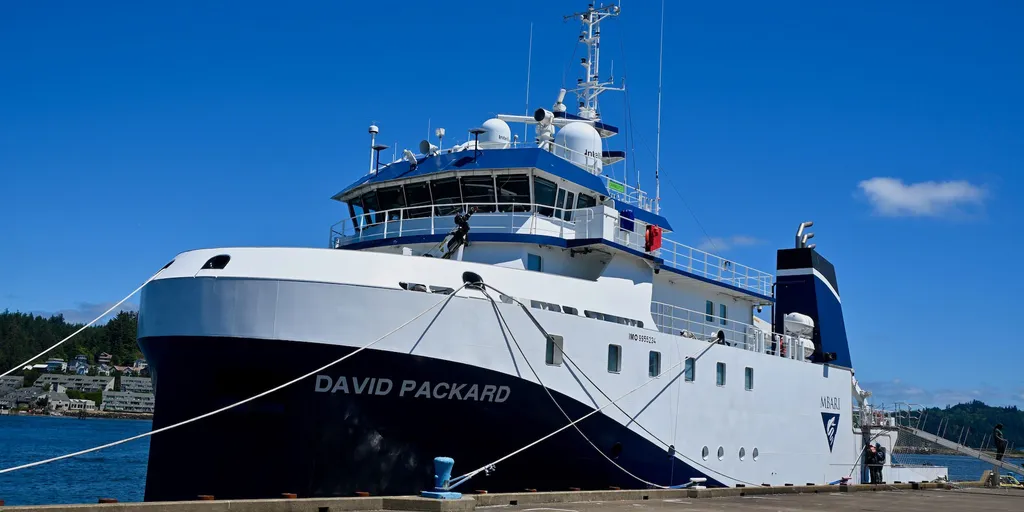
The Monterey Bay Aquarium Research Institute (MBARI) has marked a significant milestone with the completion of the first science mission aboard its new research vessel, the David Packard. The three-day expedition, which took place last month, showcased the advanced capabilities of the ROV Doc Ricketts and the David Packard, setting a new standard for deep-sea exploration and research.
The primary objective of the mission was to collect a diverse array of deep-sea animals for MBARI’s upcoming Into the Deep / En lo Profundo exhibition. This exhibit, set to be the largest collection of deep-sea animals in North America, aims to bring the mysteries of the deep ocean to the public. The ROV Doc Ricketts, with its impressive ability to dive up to 4,000 meters (approximately 2.5 miles) underwater, played a pivotal role in this endeavor. The expanded capabilities of the David Packard allowed the team to venture farther offshore, reaching Sur Ridge, a vibrant deep-sea coral garden teeming with life.
One of the standout features of the David Packard is its ability to support longer dives, extending up to 12 hours underwater. This extended dive time was crucial for the team, enabling them to collect a greater number of animals. These specimens are vital for a new Aquarium research project focused on understanding the diet and growth of deep-sea comb jellies. The longer dives not only enhanced the efficiency of the collection process but also provided more opportunities for in-depth scientific study.
The expedition also served as a platform to test and deploy innovative technology. MBARI engineers successfully deployed an “elevator” designed to safely transport deep-sea animals to the surface. This device ensures the safe stowage and retrieval of delicate marine life, minimizing stress and potential damage during ascent.
The David Packard, more than a decade in the making, is a testament to cutting-edge marine engineering. Designed by Glosten in partnership with MBARI’s marine operations team and constructed by the Spanish ship-building company Freire Shipyard, the vessel is a marvel of modern maritime technology. As Celia Konowe notes in the latest issue of Marine Technology Reporter magazine, the David Packard was aptly named after MBARI’s late founder and is equipped with demanding technical capabilities and scientific research goals. The vessel is designed to launch and recover MBARI’s six-ton remotely operated vehicle (ROV), as well as conduct a variety of other scientific tasks, including launching and recovering autonomous underwater vehicles (AUVs), deploying moorings off the stern, and collecting conductivity, temperature, and depth (CTD) measurements.
The successful completion of this mission underscores the potential of the David Packard and the ROV Doc Ricketts to advance our understanding of the deep sea. By pushing the boundaries of deep-sea exploration, MBARI is paving the way for groundbreaking research and discovery. The Into the Deep / En lo Profundo exhibition will not only educate the public but also inspire a new generation of marine scientists and conservationists. As the maritime industry continues to evolve, the collaboration between advanced technology and scientific research will be crucial in unlocking the secrets of our oceans and ensuring their preservation for future generations.