
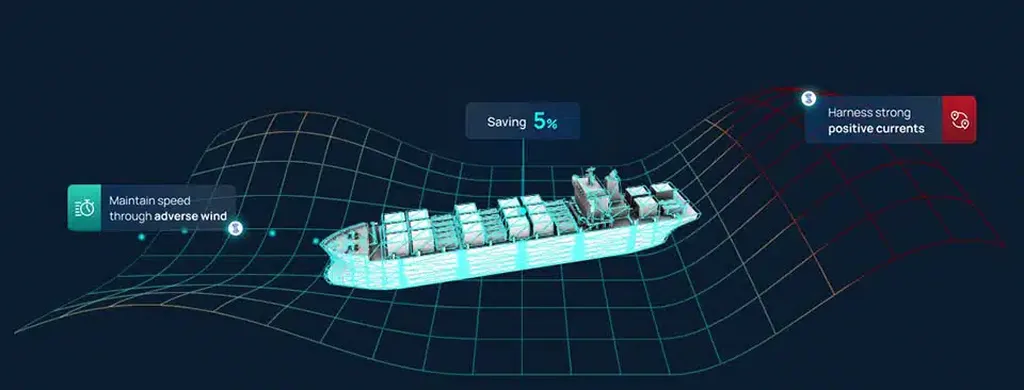
In a significant stride towards smarter and more sustainable maritime operations, researchers have developed a novel framework that optimizes ship voyage planning by integrating real-time port operations and environmental dynamics. This innovative approach, led by Youngseo Park from the Department of Artificial Intelligence and Robotics at Sejong University in Seoul, South Korea, promises to revolutionize the way container ships navigate, reducing fuel consumption and greenhouse gas emissions without compromising port schedules.
The study, published in the Journal of Marine Science and Engineering, addresses a critical gap in current voyage planning methods. Traditional approaches often overlook the variability in port operations or treat fuel optimization and just-in-time (JIT) arrivals as separate issues. Park’s research, however, presents a data-driven framework that seamlessly combines these elements, providing a more holistic and practical solution for real-world operations.
At the heart of this framework are two key predictive models. The first is a dwell-time prediction model, which uses port throughput and meteorological-oceanographic variables to estimate the required time of arrival (RTA) at the port. This model achieved a validation accuracy of R² = 0.84, offering a reliable data-driven estimate. The second model is a Transformer encoder, which forecasts fuel consumption based on navigation and environmental data, achieving an impressive R² value of approximately 0.99.
These predictive models are then embedded into a Deep Q-Network (DQN) routing model. This advanced system optimizes headings and speed profiles under varying ocean conditions, ensuring that ships can navigate efficiently and sustainably. The framework was tested on three container-carrier routes, using historical AIS trajectories as operational benchmarks. The results were striking: the optimized routes reduced fuel consumption and CO₂ emissions by approximately 26% to 69%, while minimizing JIT arrival deviations.
“The proposed framework provides a unified approach that links port operations, fuel dynamics, and ocean-aware route planning,” Park explained. This integration offers practical benefits for smart and autonomous ship navigation, making it a valuable tool for the maritime industry.
The commercial impacts of this research are substantial. By optimizing fuel consumption and reducing emissions, shipping companies can achieve significant cost savings while also meeting increasingly stringent environmental regulations. The framework’s ability to handle real-time data and adapt to changing conditions makes it particularly valuable in today’s dynamic maritime environment.
Moreover, the research opens up new opportunities for the development of smart and autonomous navigation systems. As the maritime industry continues to evolve, the demand for advanced technologies that can enhance efficiency and sustainability will only grow. Park’s work is a significant step in this direction, providing a robust foundation for future innovations.
In summary, this research represents a major advancement in maritime technology, offering a practical and effective solution for optimizing ship voyage planning. Its potential to reduce costs, improve efficiency, and enhance sustainability makes it a valuable asset for the maritime industry, paving the way for a smarter and more sustainable future.