
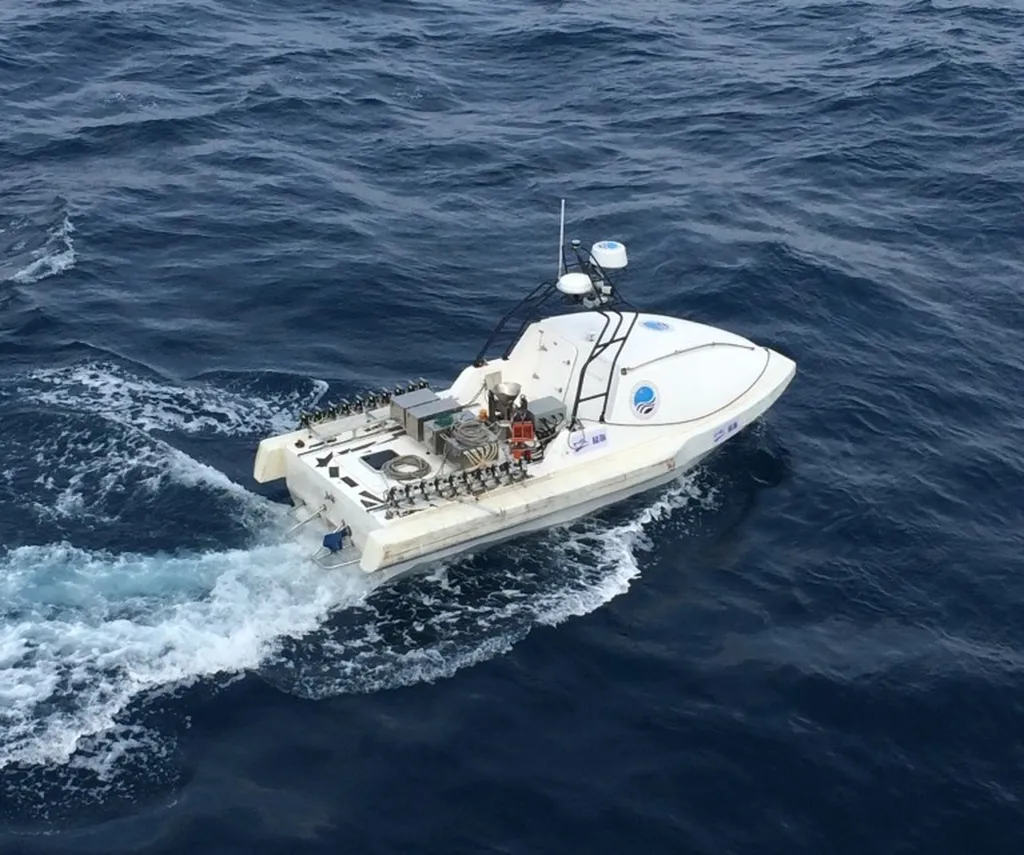
In the ever-evolving world of maritime technology, a significant breakthrough has emerged that could revolutionize the way unmanned surface vehicles (USVs) navigate and detect obstacles. Researchers, led by Hongxin Sun from the Merchant Marine College at Shanghai Maritime University, have developed a novel framework called WA-YOLO, which stands for Water-Aware You Only Look Once. This innovation is set to enhance small-object detection in challenging maritime conditions, such as glare and low-light scenarios.
The WA-YOLO framework is designed to tackle the unique challenges faced by maritime vision systems. It incorporates lightweight attention modules, known as ECA and CBAM, which help the model to better discern small objects against cluttered water ripples and glare backgrounds. This is a critical advancement, as detecting small objects in such conditions has historically been a significant challenge.
One of the key features of WA-YOLO is its use of advanced bounding box regression losses, such as SIoU. This helps improve the stability and efficiency of localization under wave disturbances. The researchers also explored the trade-off between high-resolution input and tiled inference strategies, which has significantly boosted small-object recall while carefully evaluating the impact on real-time performance on embedded devices.
Hongxin Sun explained, “Our approach offers a simple, reproducible, and readily deployable solution. We’ve systematically explored the efficacy trade-off between high-resolution input and tiled inference strategies to tackle small-object detection, significantly boosting small-object recall while carefully evaluating the impact on real-time performance on embedded devices.”
The commercial impacts of this research are substantial. Improved small-object detection can enhance the safety and efficiency of USVs, which are increasingly being used for various maritime applications, including surveying, monitoring, and security. The ability to detect obstacles more accurately in challenging conditions can prevent accidents and reduce downtime, leading to significant cost savings.
Moreover, the WA-YOLO framework’s real-time performance on both workstations and embedded devices makes it a practical solution for commercial applications. As Hongxin Sun noted, “WA-YOLO not only surpasses its detection accuracy but crucially maintains real-time performance at 118 FPS on workstations and 17 FPS on embedded devices, achieving a superior balance between precision and efficiency.”
The research, published in the Journal of Marine Science and Engineering (also known as the Journal of Marine Science and Engineering), represents a significant step forward in maritime technology. It offers a compelling solution to the challenges of small-object detection in maritime environments, with the potential to enhance the safety and efficiency of USVs.
For maritime professionals, this development opens up new opportunities for innovation and improvement in USV technology. The WA-YOLO framework’s ability to improve detection accuracy and maintain real-time performance makes it a valuable tool for a wide range of maritime applications. As the industry continues to evolve, such advancements will be crucial in meeting the growing demands for safety, efficiency, and cost-effectiveness.
In summary, the WA-YOLO framework developed by Hongxin Sun and his team at Shanghai Maritime University represents a significant advancement in maritime technology. Its ability to enhance small-object detection in challenging conditions offers substantial commercial impacts and opportunities for the maritime sector. As the industry continues to embrace technological innovations, the WA-YOLO framework is poised to play a pivotal role in shaping the future of USV technology.