
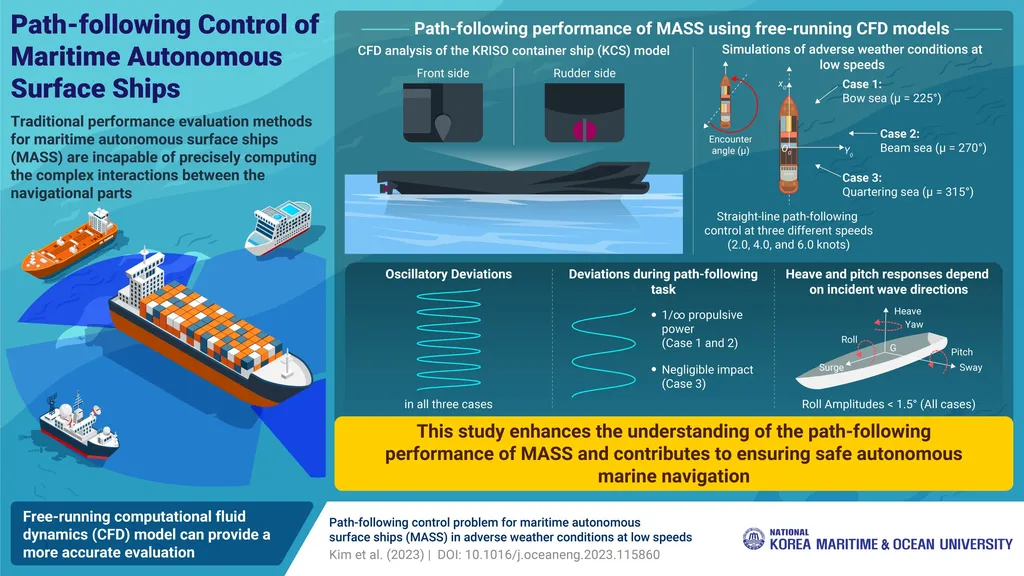
In the realm of autonomous shipping, ensuring the safety of these vessels is paramount, and that’s where the work of Jae-Yong Lee, a researcher from the Department of Maritime Transportation System at Mokpo National Maritime University in South Korea, comes into play. Lee’s recent study, published in the journal ‘Brodogradnja’ (which translates to ‘Shipbuilding’), tackles the critical issue of collision-avoidance technology, a cornerstone for the safe navigation of autonomous ships.
So, what’s the big deal? Well, current testing scenarios for collision-avoidance algorithms often fall short. They’re typically based on virtual trajectories or simplified encounters, which, as Lee points out, “have shown limitations in adequately representing real-world conditions.” To address this, Lee proposes a novel framework that uses actual collision cases to develop testing scenarios. This approach is a game-changer because it brings a level of realism that’s been missing until now.
Here’s how it works: Lee’s framework consists of three stages. First, collision cases are collected. Then, the trajectories of the ships involved are extracted and combined to reconstruct the circumstances leading up to the incident. Finally, these encounter situations are diversified and systematically categorized into a structured testing set. The result? Scenarios that exhibit distinctive characteristics derived from real collision cases, including situations where navigation rules can’t be strictly applied, dynamic encounters, speed variations, and environmental conditions.
The implications for the maritime industry are significant. As autonomous ships become more prevalent, the need for robust collision-avoidance algorithms becomes even more critical. Lee’s work provides a solid basis for validating and improving these algorithms, contributing not only to the advancement of autonomous-ship technology but also to the enhancement of maritime safety.
From a commercial perspective, this research opens up opportunities for maritime sectors to invest in and develop more reliable collision-avoidance systems. It also underscores the importance of using real-world data to test and validate these systems, ensuring they’re ready for the complexities of actual maritime environments.
In the words of Lee, “By reflecting real maritime environments, these scenarios provide a solid basis for validating and improving collision-avoidance algorithms.” And that, in a nutshell, is what this research is all about. It’s a step forward in making autonomous shipping safer and more reliable, benefiting the maritime industry as a whole.