
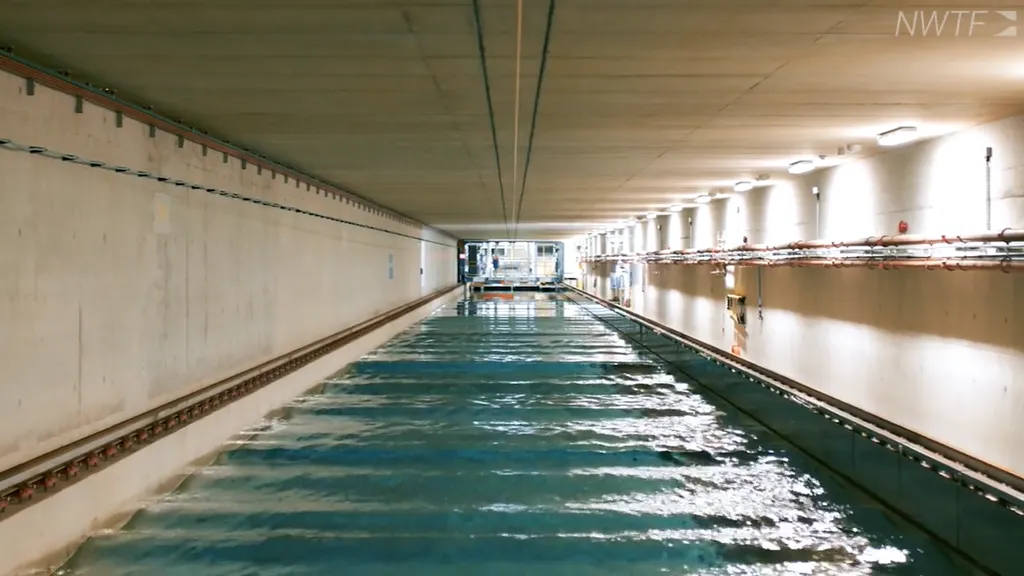
Researchers at the University of Southampton, led by B Malas, have successfully designed, developed, and commissioned a new towing tank facility, marking a significant milestone in the institution’s long-standing reputation in naval architecture and hydrodynamics. The new towing tank, a project spanning over a decade, addresses a long-standing need for a middle-sized facility to support teaching, research, and commercial experiments previously outsourced due to lack of in-house capabilities.
The renovation of the Boldrewood campus in the early 2010s provided the opportunity to construct this much-needed facility. The new towing tank measures 138 meters in length, 6 meters in width, and 3.5 meters in depth. This state-of-the-art facility is equipped with a 12 independent paddles wavemaker, allowing for the generation of complex wave patterns essential for advanced hydrodynamic studies. Additionally, the tank features an innovative carriage capable of reaching speeds of up to 10 meters per second, enhancing the versatility and efficiency of experimental setups.
The journey to commissioning the towing tank was fraught with challenges and delays, which the researchers meticulously documented. These hurdles included technical, logistical, and financial obstacles that required innovative solutions and persistent effort to overcome. Despite these challenges, the team’s dedication ensured that the facility met the highest standards of design and functionality.
The technical solutions and equipment chosen for the towing tank are detailed in the research, highlighting the advanced technology integrated into the facility. The 12 independent paddles wavemaker, for instance, allows for precise control over wave generation, enabling a wide range of experimental conditions to be simulated. The high-speed carriage further enhances the tank’s capabilities, providing researchers with the tools needed to conduct cutting-edge experiments in hydrodynamics.
Validation experiments were conducted to ensure the accuracy and reliability of the new towing tank. These experiments confirmed that the facility meets the required standards for teaching, research, and commercial applications. The successful commissioning of the towing tank represents a significant achievement for the University of Southampton, reinforcing its position as a leader in naval architecture and hydrodynamics.
The new towing tank will significantly enhance the university’s ability to conduct advanced research and provide high-quality education in naval architecture. It will also attract commercial projects, further solidifying the university’s reputation as a hub for innovation and excellence in the field. The facility’s advanced capabilities will enable researchers to tackle complex hydrodynamic challenges, contributing to the development of new technologies and solutions for the maritime industry. Read the original research paper here.