
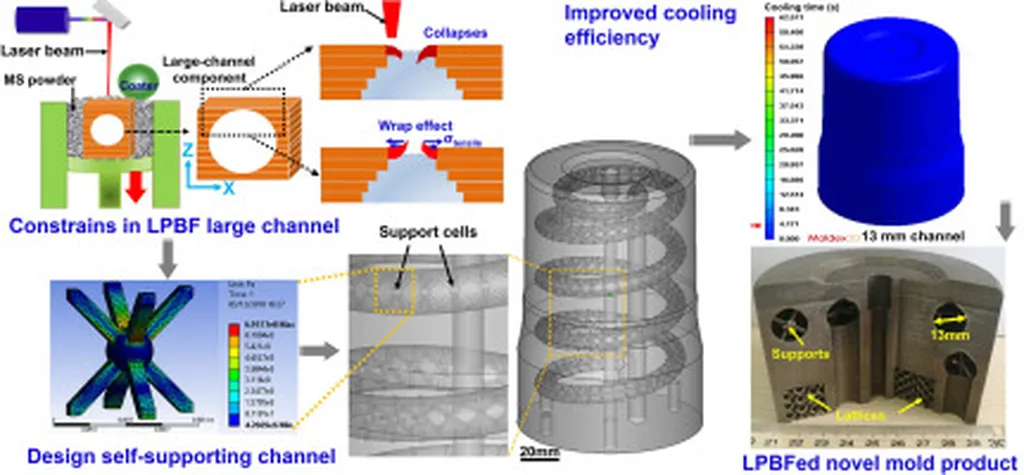
In a breakthrough that could reshape the way molds are manufactured, researchers have developed a novel method for embedding cooling channels using a combination of press-fit and directed energy deposition (DED). This innovation, led by Hyun-Tae Park from the Department of Ocean Advanced Materials Convergence Engineering at Korea Maritime and Ocean University, promises to enhance the cooling efficiency of molds, a critical factor in the quality of thermoplastic polymeric products.
The study, published in the Journal of Materials Research and Technology (translated from the original Spanish title), explores three distinct fabrication methods: round, flat-sink, and flat-half. Each method was evaluated based on deposition characteristics, channel geometry, cross-sectional area, and width. The findings reveal that the flat-sink method, where the tube is positioned below the mold surface, effectively prevents thermal deformation during the deposition process. “The groove dimensions affect the pressure between the mold and tube,” Park explains. “Excessive pressure can cause tube buckling, while insufficient pressure leads to thermal deformation.”
The round method, while offering better fusion between the tube and deposited powder, complicates the deposition path setting. The flat-sink configuration emerged as the most efficient, minimizing the gap at the tube-mold interface and providing a larger coolant cross-sectional area. This resulted in a 15.1% higher initial cooling rate compared to the round configuration.
For the maritime industry, the implications are substantial. The ability to produce molds with superior cooling characteristics can lead to higher-quality products, reduced production times, and cost savings. “The groove dimensions and tube geometry jointly control tube deformation, dilution behavior, and cooling performance,” Park notes. This research offers practical guidelines for designing tube-embedded cooling channels in additively manufactured molds, paving the way for advancements in various sectors, including maritime.
The commercial impact of this innovation is significant. Enhanced cooling channels can improve the efficiency of mold production, which is crucial for industries relying on high-quality thermoplastic products. From shipbuilding to offshore structures, the applications are vast. The study’s findings provide a roadmap for manufacturers to optimize their processes, ensuring better product quality and operational efficiency.
In summary, this research represents a step forward in additive manufacturing, particularly in the realm of mold production. By addressing the challenges associated with cooling channel fabrication, Hyun-Tae Park and his team have opened new avenues for innovation in the maritime and other industries. The study’s publication in the Journal of Materials Research and Technology underscores its relevance and potential impact on industrial practices.