
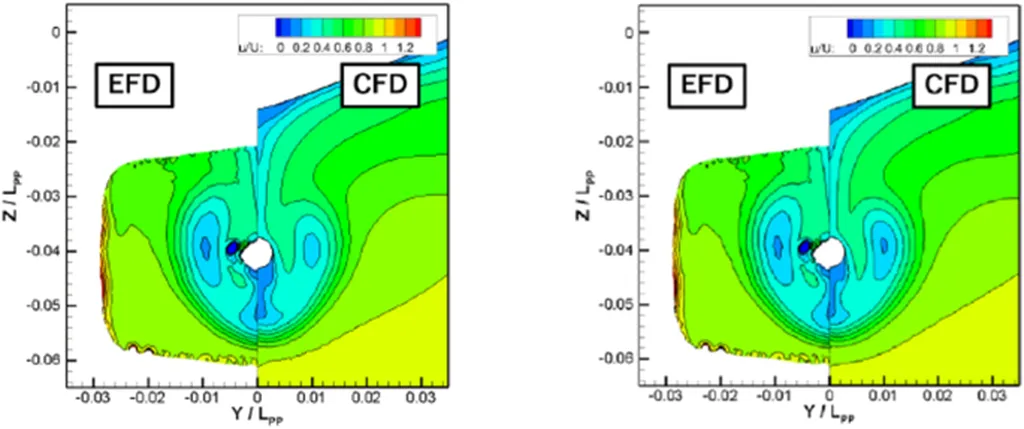
Researchers from the KTH Royal Institute of Technology in Stockholm have made significant strides in the field of computational fluid dynamics, specifically in the realm of turbulence simulations. Their work, which leverages modern Fortran and advanced GPU technology, promises to revolutionize the way we approach sustainable shipping. The team, comprising Martin Karp, Daniele Massaro, Niclas Jansson, Alistair Hart, Jacob Wahlgren, Philipp Schlatter, and Stefano Markidis, has successfully conducted the world’s first direct numerical simulation of the flow around a Flettner rotor at a Reynolds number of 30,000 and its interaction with a turbulent boundary layer. This achievement marks a pivotal moment in the application of high-performance computing to real-world maritime challenges.
The researchers employed the spectral element method, a powerful numerical technique that combines the geometric flexibility of finite elements with the accuracy of spectral methods. This approach allows for the simulation of complex turbulent flows with unprecedented detail and precision. By utilizing supercomputers equipped with Nvidia A100 and AMD Instinct MI250X GPUs, the team was able to scale their simulations efficiently, demonstrating the potential of modern hardware in tackling computationally intensive problems.
One of the most notable aspects of this research is the performance comparison between the AMD Instinct MI250X and Nvidia A100 GPUs. The results indicate that a single MI250X GPU offers performance comparable to two A100 GPUs, while maintaining similar power efficiency. This finding is significant for the field of computational fluid dynamics, as it provides valuable insights into the capabilities and limitations of different GPU architectures.
The practical applications of this research are vast, particularly in the realm of sustainable shipping. By understanding and optimizing the flow around Flettner rotors, which are used to propel ships using the Magnus effect, the researchers aim to reduce fuel consumption and emissions. This aligns with global efforts to make maritime transportation more environmentally friendly and economically viable.
The team’s use of modern Fortran is also noteworthy. Fortran, one of the oldest high-level programming languages, has been continuously updated to meet the demands of modern computing. Its efficiency and performance make it an ideal choice for scientific and engineering applications, particularly those involving large-scale numerical simulations.
In summary, the research conducted by the team at the KTH Royal Institute of Technology represents a significant advancement in the field of computational fluid dynamics. By leveraging modern Fortran and advanced GPU technology, they have demonstrated the potential to optimize maritime propulsion systems, contributing to the broader goal of sustainable shipping. Their work not only pushes the boundaries of what is computationally possible but also provides practical solutions to real-world challenges. Read the original research paper here.