
Researchers Arkadiusz Ryś, Lucas Lima, Joeri Exelmans, Dennis Janssens, and Hans Vangheluwe from the University of Antwerp have introduced a groundbreaking framework designed to revolutionize model management in systems engineering workflows. Their work, which leverages ontology-based knowledge graphs, addresses the evolving landscape of system engineering, which is increasingly shifting from document-centric to model-based approaches.
The researchers highlight that while digitization offers numerous benefits, it also presents challenges such as storage and access. In the context of Cyber-Physical Systems (CPS), experts from various domains execute complex workflows and manipulate models in a myriad of formalisms, each with its own methods, techniques, and tools. The proposed framework aims to manage modeling artifacts generated from these workflow executions, thereby reducing effort during system development and ensuring repeatability and replicability.
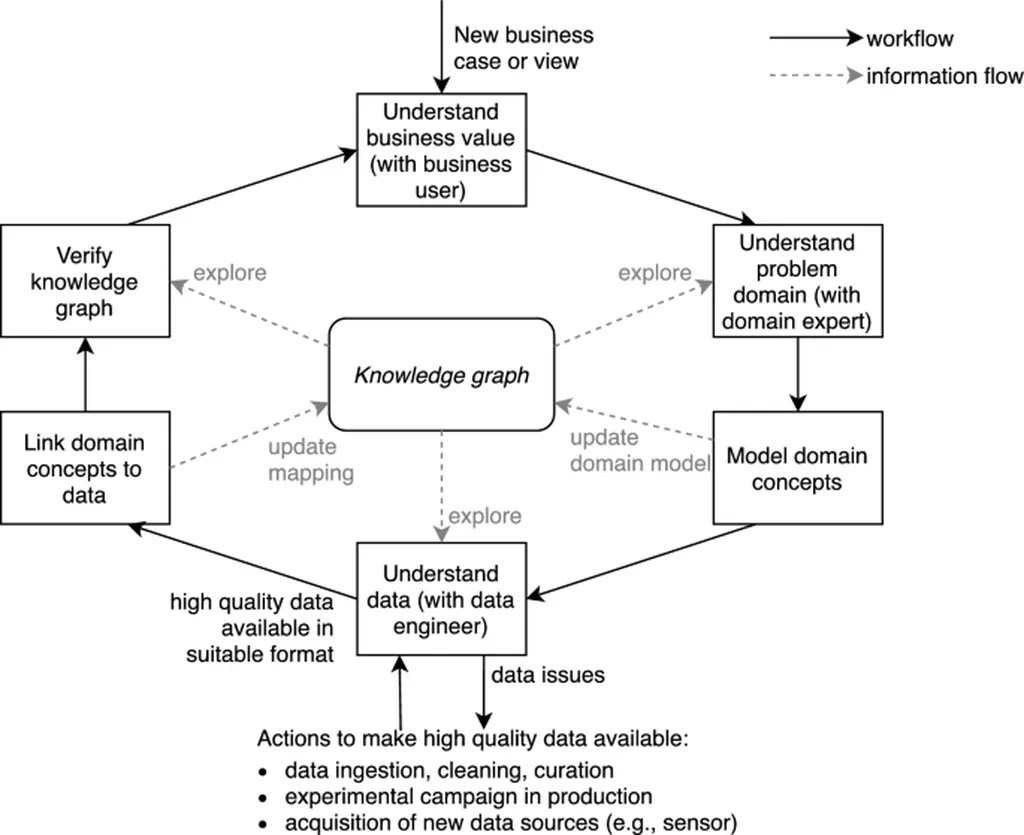
The framework’s foundation lies in an ontology specified in the Ontology Modelling Language (OML), which formally defines basic workflow concepts, related formalisms, and artifacts. This ontology enables the construction of a knowledge graph that contains system engineering data, facilitating reasoning and querying. The researchers have also developed several tools to support system engineering during the design of workflows, their enactment, and artifact storage, considering versioning, querying, and reasoning on the stored data. These tools are designed to hide the complexity of manipulating the knowledge graph directly.
In a real-world application, the researchers applied their framework to the development of a drivetrain smart sensor system. The results demonstrated that the framework not only assisted system engineers with fundamental challenges like storage and versioning but also significantly reduced the time needed to access relevant information. Additionally, the knowledge graph allowed for the inference of new knowledge, showcasing the framework’s potential to enhance efficiency and productivity in systems engineering workflows. Read the original research paper here.