
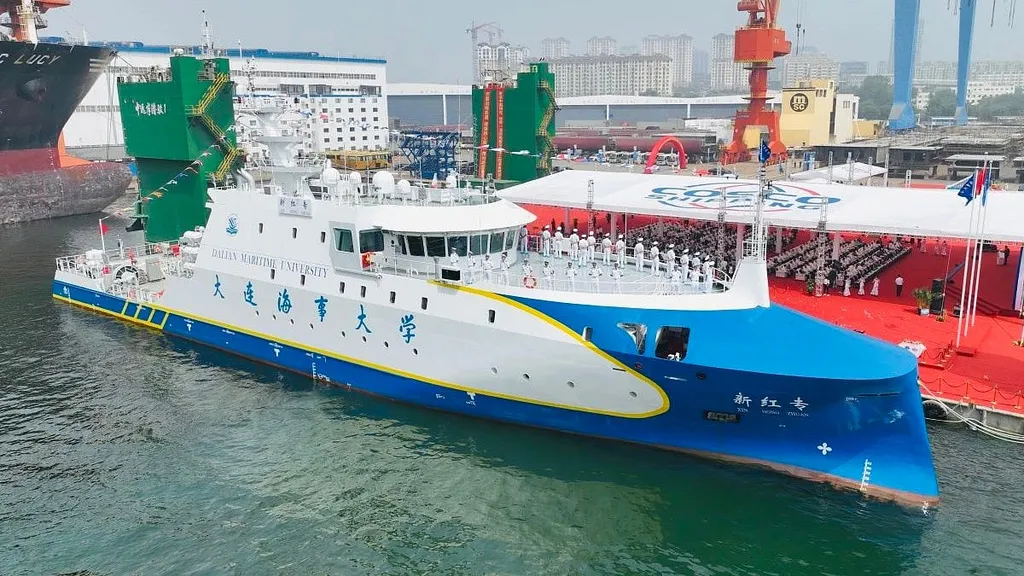
In a groundbreaking development poised to revolutionize human-machine interaction systems, researchers have introduced a novel approach to estimate continuous upper limb movements using surface electromyography (sEMG) signals. This innovation, spearheaded by Chuang Lin from the School of Information Science and Technology at Dalian Maritime University, promises to enhance the precision and naturalness of interactions between humans and machines, a critical factor in maritime operations where dexterity and control are paramount.
The study, published in the esteemed journal ‘Scientific Reports’ (which translates to ‘Nature Research’), focuses on the estimation of upper-limb movements, particularly the intricate motions of the elbow and shoulder joints. Traditional methods often grapple with the challenge of muscle deformations around these joints, which can lead to inaccurate sensor readings. However, the proposed Linear-Attention-based model (LABD) addresses this issue by leveraging advanced deep learning techniques to provide more accurate and reliable estimates.
Chuang Lin explains, “The deformations of muscles around the elbow and shoulder can cause the shifting of the angle sensors. Nevertheless, Vicon can measure joint angles using cameras that have no contact with muscles.” This insight underscores the importance of the new model, which utilizes sEMG signals collected from eight sensors and compares them with angles measured by Vicon, a high-precision motion capture system.
The experimental results of the LABD were compared with several other deep learning models, including multilayer perceptrons (MLP), Temporal Convolutional Network (TCN), long short-term memory network (LSTM), and a dot-product attention-based model (DABD). The performance of each model was evaluated using Pearson correlation coefficients (PCC) between the target and estimated joint angle sequences. The findings revealed that the LABD significantly outperformed the other models, as evidenced by the Wilcoxon signed-rank results.
For the maritime sector, the implications of this research are profound. Accurate and continuous estimation of upper limb movements can enhance the operability of remote-controlled and autonomous systems, improving the efficiency and safety of maritime operations. From controlling robotic arms in underwater exploration to operating complex machinery on deck, the applications are vast and varied.
Moreover, the integration of such advanced models into maritime training programs can provide more realistic and effective simulations, better preparing crew members for real-world scenarios. The potential for commercial impact is substantial, with opportunities for innovation in maritime robotics, autonomous vessels, and advanced training systems.
As the maritime industry continues to evolve, the need for more intuitive and precise human-machine interfaces becomes increasingly critical. The work of Chuang Lin and his team represents a significant step forward in this domain, offering a glimpse into a future where technology and human dexterity are seamlessly intertwined.