
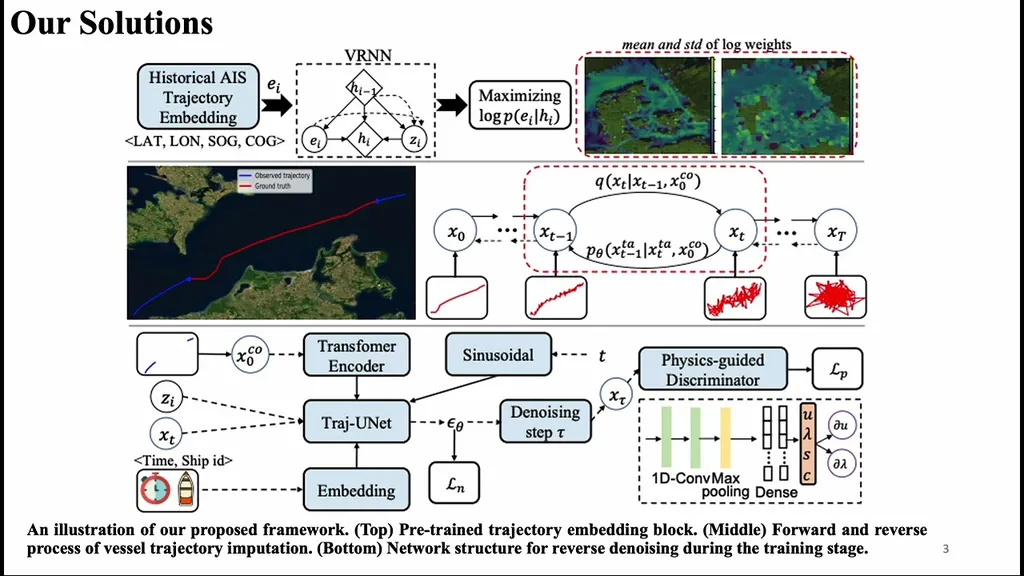
Researchers from the Department of Computer Science at Aalborg University have introduced a groundbreaking framework designed to enhance the accuracy and interpretability of vessel trajectory imputation. The team, led by Hengyu Liu and including Tianyi Li, Haoyu Wang, Kristian Torp, Tiancheng Zhang, Yushuai Li, and Christian S. Jensen, has developed a system called VISTA (Knowledge-Driven Interpretable Vessel Trajectory Imputation). This innovative approach leverages large language models to address the challenges posed by incomplete Automatic Identification System (AIS) data, which is crucial for maritime navigation and safety.
The Automatic Identification System (AIS) is a critical tool for maritime navigation and safety, providing real-time information about vessel positions, courses, and speeds. However, AIS trajectories are often incomplete due to signal loss, equipment failure, or deliberate tampering. Existing methods for trajectory imputation focus primarily on recovering missing data points but often overlook the interpretability of the results and the underlying knowledge that could benefit downstream tasks such as anomaly detection and route planning. The researchers at Aalborg University have addressed these limitations with VISTA, a novel framework that not only improves imputation accuracy but also provides interpretable knowledge to support further analysis.
VISTA stands out by defining underlying knowledge as a combination of Structured Data-derived Knowledge (SDK) and Implicit LLM Knowledge. SDK is extracted from AIS data, while Implicit LLM Knowledge is acquired from large-scale internet corpora. The framework employs a data-knowledge-data loop, which uses a Structured Data-derived Knowledge Graph for SDK extraction and knowledge-driven trajectory imputation. This loop ensures that the knowledge is effectively managed and leveraged at scale. To handle the vast amounts of AIS data efficiently, VISTA incorporates a workflow management layer. This layer coordinates the end-to-end pipeline, enabling parallel knowledge extraction and trajectory imputation while managing anomalies and eliminating redundancies.
The researchers conducted experiments on two large AIS datasets to evaluate VISTA’s performance. The results demonstrated that VISTA achieves state-of-the-art imputation accuracy and computational efficiency, outperforming existing baselines by 5%-94% in accuracy and reducing time costs by 51%-93%. Moreover, VISTA produces interpretable knowledge cues that significantly benefit downstream tasks. The source code and implementation details of VISTA are publicly available, allowing other researchers and practitioners to build upon this innovative framework.
The practical applications of VISTA in the marine sector are substantial. Accurate and interpretable vessel trajectory imputation can enhance maritime safety by providing more reliable data for navigation and collision avoidance. It can also improve route planning and optimize fuel consumption by offering better insights into vessel movements. Additionally, the knowledge-driven approach of VISTA can support anomaly detection, helping to identify and mitigate potential risks such as piracy, smuggling, and environmental violations. By making the framework publicly available, the researchers have enabled the broader maritime community to leverage these advancements, potentially leading to safer and more efficient maritime operations. Read the original research paper here.